
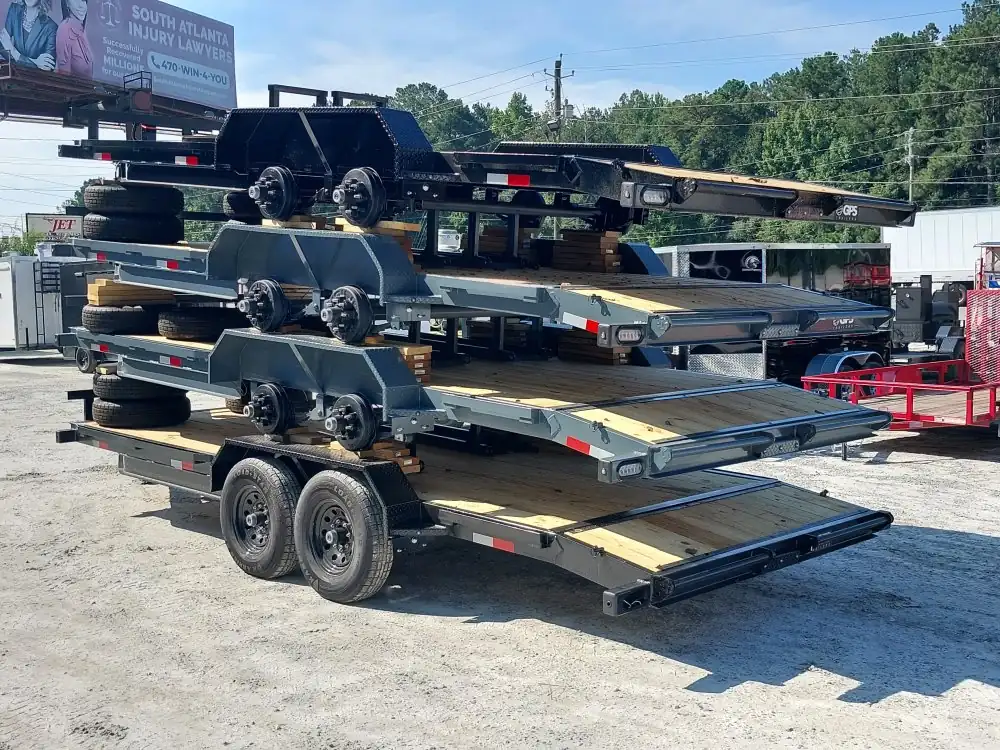
Loading a skid steer is one of those jobs that goes smoothly a hundred times and badly once. Most problems come from the same few mistakes: loading on a slope, misjudging the ramps, carrying the bucket high or skipping a chain. Here is a step-by-step routine for loading a skid steer on a trailer and tying it down for the road.
Always read your machine's operator's manual first. It lists the operating weight, the tie-down points and the manufacturer's loading instructions, and those come first.
Step 1: Make Sure the Trailer Can Carry It
Look up the machine's operating weight and add the attachment, fuel and anything else riding along. Compare that total to the trailer's payload, which is the GVWR minus the empty trailer weight.
| New trailer on our lot | GVWR | Listed empty weight | Approx. payload |
|---|---|---|---|
| 7x20 equipment trailer | 14,000 lb | 2,775 lb | 11,225 lb |
| 7x20 heavy equipment trailer | 16,000 lb | 3,720 lb | 12,280 lb |
| 7x24 heavy equipment trailer | 16,000 lb | 4,350 lb | 11,650 lb |
Check your truck as well: towing capacity, tongue weight and hitch ratings all need to cover the loaded trailer. Our post on what size trailer you need for a skid steer goes deeper on matching machine to deck.
Step 2: Set Up on Firm, Level Ground
- Park the truck and trailer in a straight line on firm, level ground. Loading on a side slope is a common cause of machines sliding off ramps.
- Set the truck's parking brake and chock the trailer wheels.
- Keep the trailer hitched. Loading a detached trailer can tip it.
- Lower the tongue jack to support the front if your trailer's design calls for it.
- Clear mud, clay, ice and debris off the ramps, the deck and the machine's tracks or tires. Wet Georgia red clay on a steel ramp is slick.
Step 3: Set the Ramps
Lower the rear ramps and space them to match the machine's track or wheel width. Make sure they are fully seated and pinned if your trailer uses pins. Look at the angle; if it is steep, work slowly and keep the machine square to the ramps.
Step 4: Drive On Slowly and Straight
Follow your manual's direction for loading. Many skid steer manuals call for keeping the heavy end of the machine uphill on the ramps. For most skid steers without a load in the bucket, the rear is the heavy end, so they back on. Whatever your manual says:
- Carry the bucket or attachment low, just above the ramp surface.
- Use slow, steady throttle. Do not turn or stop halfway up the ramps.
- Use a spotter who stays clear of the ramps and the machine's path.
- Wear your seat belt and lower the lap bar.
Step 5: Position the Machine on the Deck
Center the skid steer side to side, and place it so about 60 percent of the total load sits ahead of the trailer axles. Too far back lifts the tongue and causes sway; too far forward overloads the hitch and the truck's rear axle. Check that the trailer and truck sit about level.
Step 6: Lower and Shut Down
- Lower the bucket or attachment flat to the deck.
- Set the machine's parking brake and shut it off.
- Remove the key and cycle the hydraulic controls per your manual to relieve pressure.
Step 7: Chain It at Four Points
Use grade-rated chains and binders or rated straps at the machine's designated tie-down points, one at each corner, pulling outward and away from the machine so they work against each other. Then secure the attachment to the deck.
The federal rule for heavy equipment, 49 CFR 393.130, calls for accessory equipment to be completely lowered and secured and for machines to be restrained with at least four tiedowns, placed as close as practical to the front and rear. It applies to machines of 10,000 lb or more and is a good standard for smaller ones.
Step 8: Check Before and During the Trip
- Raise and secure the ramps.
- Check that the coupler is latched, the safety chains are crossed and the breakaway cable is connected.
- Test the lights and trailer brakes.
- Recheck every chain and binder after the first few miles and at each stop.
Common Mistakes to Avoid
- Loading with the trailer unhitched or on a slope.
- Raising the bucket high for visibility on the ramps.
- Using straps or chains not rated for the machine's weight.
- Skipping the attachment tie-down.
Unloading
Unload on firm, level ground and reverse the steps: remove the chains only once the truck is parked and chocked, start the machine, raise the attachment just enough to clear and come down the ramps slowly and straight, heavy end uphill.
Shop Equipment Trailers
We keep 7x20 and 7x24 equipment trailers on our Jonesboro lot. Browse equipment trailers for sale with real photos and stock numbers, and bring your machine's specs so we can help you compare ratings and ramps.
Paying over time? We offer traditional trailer financing, no credit check rent to own on new standard trailers with 15% down for buyers in Georgia and 20 other states, and lease-to-own through ClickLease, which starts with a soft credit pull and is available in all 50 states. See our trailer financing options for the details.
Come see us at 8834 Tara Blvd, Jonesboro, GA 30236, just south of Atlanta. We are open Monday to Friday 9 AM to 5 PM and Saturday 9 AM to 4 PM. Call (770) 603-8511 or text (404) 383-8194 Tell us what machine you run and we will show you trailers rated for it.
Frequently Asked Questions
Do you back a skid steer onto a trailer?
Follow your operator's manual. Many call for keeping the heavy end uphill on the ramps, which for most skid steers with an empty bucket means backing on.
How many tie-downs does a skid steer need?
Use at least four, one at each corner at the machine's designated tie-down points, and secure the lowered attachment too. Federal rules require at least four tiedowns on heavy equipment of 10,000 lb or more.
What size trailer do I need for a skid steer?
Most compact skid steers fit a 7x20 equipment trailer. Compare the machine's operating weight plus attachment to the trailer's payload; our 7x20 units are rated 14,000 and 16,000 lb GVWR.
Where should a skid steer sit on the trailer?
Centered side to side with about 60 percent of the load ahead of the trailer axles, so the hitch carries steady tongue weight.