
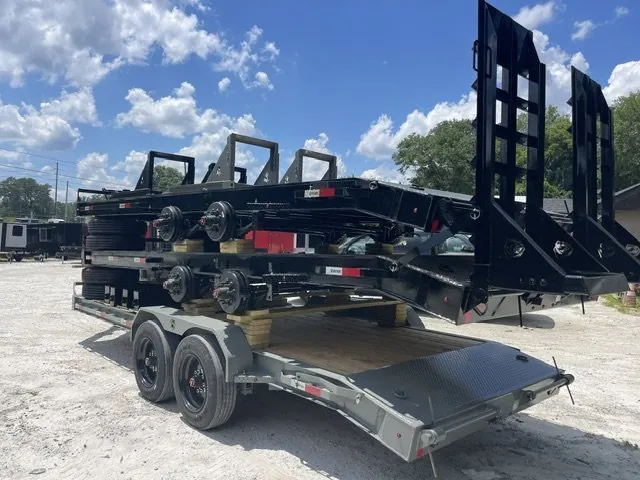
A skid steer or mini excavator is a big investment, and the trailer that hauls it matters just as much. Pick one that is too small and you overload the axles or hang the bucket off the deck. Pick one that is too big and you pull extra weight on every trip. This guide walks through how to size an equipment trailer for compact machines, using the specs from equipment trailers on our lot.
Start With Your Machine's Real Weight
The number that matters is the machine's operating weight plus everything that rides with it. Find the operating weight in the owner's manual or on the spec plate, then add:
- Buckets and attachments you carry, such as a grapple, auger or breaker
- Tracks or tire upgrades, if they are not included in the listed weight
- Fuel, tools and any extra gear on the deck
Compact machines vary a lot, from small mini excavators to large compact track loaders. Two machines that look similar can differ by thousands of pounds, so use your machine's numbers, not a guess.
Then Check Trailer Payload, Not Just GVWR
GVWR is the most a trailer can weigh loaded. Payload is GVWR minus the trailer's empty weight. Here are listed specs from recent equipment trailers we have stocked:
| Trailer | Axles | Listed empty weight | GVWR | Approximate payload |
|---|---|---|---|---|
| 7x20 equipment trailer | Two 7,000 lb | 2,775 lb | 14,000 lb | 11,225 lb |
| 7x20 heavy equipment trailer | Tandem | 3,720 lb | 16,000 lb | 12,280 lb |
| 7x24 heavy equipment trailer | Two 8,000 lb | 4,350 lb | 16,000 lb | 11,650 lb |
As a working rule, keep the machine plus attachments comfortably under the payload, rather than right at it. That leaves margin for the extra items that always seem to end up on the deck. Our post on equipment trailer weights covers these ratings in more detail.
Deck Length and Width
Length needs to fit the machine with the bucket or blade resting on the deck, plus enough room to place the machine so that about 60% of its weight sits ahead of the trailer axles. That balance gives you proper tongue weight and keeps the trailer from swaying.
For many skid steers and mini excavators, a 7x20 deck gives room to position the machine correctly. A 7x24 adds space for a second attachment, a pallet of material or a longer machine. Width matters as well: measure the machine's track or tire width and make sure it fits between the fenders, or that the trailer is a deck-over design if the machine is wider.
Ramps and Loading Angle
Equipment trailers on our lot use rear ramps. Check that the ramp spacing fits your tracks or tires, and that the ramps are rated for your machine. A tracked machine is sensitive to a steep loading angle, so load on level ground, keep the tow vehicle and trailer in a straight line and drive up slowly and squarely.
Example: Sizing a Trailer for a Mid-Size Machine
Say your machine weighs 7,500 lb with its bucket, and you also carry a 600 lb attachment and 200 lb of tools and chains. That is 8,300 lb of cargo.
- A 7x20 rated at 14,000 lb GVWR with about 11,225 lb of payload carries it with margin to spare.
- If you plan to move up to a heavier machine later, a 16,000 lb GVWR trailer gives you more room to grow.
Next, add the trailer's empty weight: 8,300 lb of cargo on a 2,775 lb trailer is about 11,075 lb total. Your truck's towing capacity must cover that number, and its payload must handle the tongue weight, roughly 10% to 15% of the loaded trailer.
Tie-Downs for Heavy Equipment
Machines need to be chained down every trip, with buckets, blades and booms lowered to the deck. The federal FMCSA cargo securement rules include specific requirements for heavy vehicles and equipment, including how they are restrained at the front and rear. Even if you are not a commercial carrier, they are a sound standard to follow. Use chains and binders rated for the load, attach them to the machine's tie-down points and check them after the first few miles.
Georgia Weight Rules for Business Use
Hauling equipment for work puts you in the weight range where Georgia's commercial motor vehicle rules apply. According to the Georgia Department of Public Safety motor carrier FAQ, business vehicles or combinations with a weight rating of 10,001 lb or more need a USDOT number, a medical card and must stop at weigh stations. A CDL applies once the combination reaches 26,001 lb. Check your truck and trailer ratings together before you buy.
See Equipment Trailers in Person
Browse our equipment trailers for sale or go straight to 7x20 equipment trailers. Bring your machine's specs, and we will help you compare payload and deck length. Regular trailers are picked up at our Jonesboro lot, and payment is made in person.
Paying over time? We offer traditional trailer financing, no credit check rent to own on new standard trailers with 15% down for buyers in Georgia and 20 other states, and lease-to-own through ClickLease, which starts with a soft credit pull and is available in all 50 states. See our trailer financing options for the details.
Come see us at 8834 Tara Blvd, Jonesboro, GA 30236, just south of Atlanta. We are open Monday to Friday 9 AM to 5 PM and Saturday 9 AM to 4 PM. Call (770) 603-8511 or text (404) 383-8194 and tell us what machine you are hauling.
Frequently Asked Questions
What size trailer do I need for a skid steer?
Many skid steers fit on a 7x20 equipment trailer, but size the trailer by your machine's operating weight plus attachments. Keep that total comfortably below the trailer's payload.
What size trailer do I need for a mini excavator?
Check the machine's operating weight and width. Many mini excavators fit on a 7x20 deck, while heavier machines or extra attachments may call for a 16,000 lb GVWR or 7x24 trailer.
How much can a 7x20 equipment trailer carry?
A 7x20 on our lot rated at 14,000 lb GVWR with a listed 2,775 lb empty weight carries about 11,225 lb. A 7x20 rated at 16,000 lb with a 3,720 lb empty weight carries about 12,280 lb.
Where should I place a skid steer on the trailer?
Position it so about 60% of the total weight is ahead of the trailer axles, with the bucket lowered to the deck. That gives proper tongue weight and reduces sway.
Do I need a USDOT number to haul my own equipment in Georgia?
If you haul for business and your truck and trailer have a combined weight rating of 10,001 lb or more, Georgia requires a USDOT number, a medical card and weigh station stops. Check with the Georgia Department of Public Safety.