
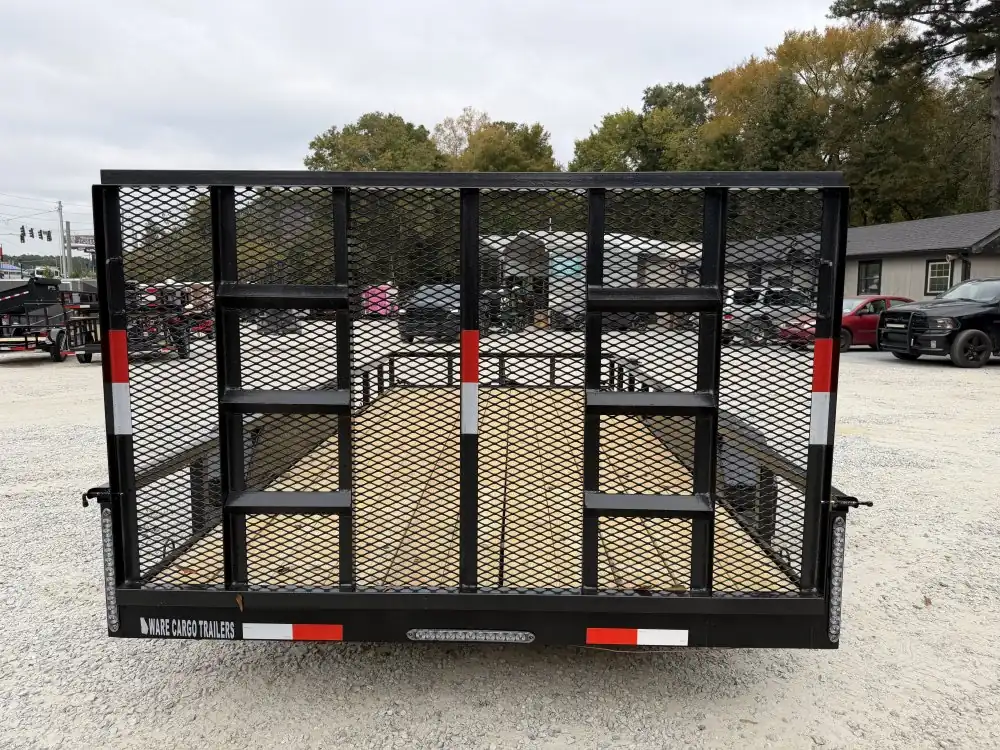
A zero-turn mower is wider than most people expect once you add the deck and discharge chute, and it is heavier than a push mower by a wide margin. Pick a trailer that is too narrow and you will be scraping rails at every load. Pick one that is too light and you will run out of payload before you add a trimmer and fuel cans. Here is how to size a utility trailer for a zero-turn mower, whether you cut your own yard or run a lawn route.
Step 1: Measure the Mower
Do not go by the deck size on the sticker alone. A mower sold as a 60-inch deck can be wider overall once you add the discharge chute and deck wheels. Measure three things with a tape:
- Overall width with the chute down, at the widest point.
- Overall length from the front caster wheels to the rear bumper or hitch plate.
- Weight from your owner's manual or spec sheet, plus fuel and any attachments such as a bagger or striping kit.
Then measure the trailer. Trailer sizes like 6x12 describe roughly the deck width and length. What matters is the usable width between the rails and the width of the gate opening, so measure those on the trailer itself.
Step 2: Pick a Width
Here is how common utility trailer widths line up with mowers:
| Trailer width | Typical fit |
|---|---|
| 5 feet | Small residential zero-turns and lawn tractors with narrower decks |
| 6 to 6.5 feet | Most residential zero-turns and many mid-size commercial mowers |
| 7 feet | Wide commercial decks, or two mowers side by side in some cases |
Leave a few inches on each side. You want room to drive straight up the gate without clipping a rail, and space to reach the tie-down points once the mower is parked.
Step 3: Pick a Length
Length is about everything else you carry. A single zero-turn fits on a 10-foot deck with room for a trimmer rack. A 12-foot deck adds space for a push mower, a blower and fuel cans. Lawn crews running two mowers, or a mower plus a bagger and hand tools, often move to 14 or 16 feet.
Keep in mind that the heavy mower should sit slightly ahead of the axle so you get proper tongue weight. On a short trailer, that leaves less room for gear behind it.
Step 4: Check the Weight Rating
Payload is GVWR minus the trailer's empty weight. Here are new utility trailers on our lot:
| Trailer | Empty weight | GVWR | Payload |
|---|---|---|---|
| 5x10 single axle | About 700 lb | 2,950 lb | About 2,250 lb |
| 6x10 single axle | About 800 lb | 2,950 lb | About 2,150 lb |
| 6x12 single axle | About 800 lb | 2,950 lb | About 2,150 lb |
| 6x14 with a 5,200 lb axle | About 990 lb | 5,200 lb | About 4,210 lb |
| 6.5x14 dual axle with 2-foot mesh sides | About 1,350 lb | 7,000 lb | About 5,650 lb |
| 7x16 with two 3,500 lb axles | About 1,820 lb | 7,000 lb | About 5,180 lb |
Add up the mower, a second mower if you carry one, trimmers, blowers, fuel and anything else on board. Commercial zero-turns can weigh well over 1,000 lb on their own, so a crew with two of them plus gear will need a tandem-axle trailer. Our GVWR guide walks through the math.
Single Axle or Tandem?
For one residential mower and a few hand tools, a single-axle 5x10, 6x10 or 6x12 is usually plenty, and it is light and easy to move by hand. If you haul two mowers, run a commercial route every day or spend a lot of time on the highway, a tandem axle carries more weight and tracks more steadily. In Georgia, a trailer needs brakes when its gross weight tops 3,000 lb, which is one reason the light single-axle trailers above are rated just under that line.
Gate and Loading Tips
- Use the gate as a ramp. The rear gate on a utility trailer folds down so you can drive the mower on. Make sure it is fully down and resting on firm ground.
- Follow your mower manual on direction. Many manuals tell you to back a riding mower up a ramp and drive forward down it to reduce the chance of tipping. Check yours.
- Go slow and straight. Line up square to the trailer before you start up the gate.
- Set the parking brake and lower the deck once the mower is in place.
Strapping the Mower Down
Use at least two ratchet straps on the mower frame, not on the deck, seat or handles. Pull the straps in opposite directions so the mower cannot roll forward or back. Federal cargo securement rules apply to commercial vehicles, but the same idea helps any owner: tie down every heavy item so it cannot shift. Strap trimmers and blowers into a rack or tie them to the rails, and secure fuel cans upright.
Common Picks
- Homeowner with one zero-turn: 5x10 or 6x10 single axle.
- Homeowner with a mower plus yard gear: 6x12 single axle.
- Part-time lawn route: 6x14 or 6.5x14 with mesh sides for clippings and leaves.
- Full-time crew with two mowers: 7x16 tandem axle.
You can compare current sizes on our utility trailers page. Bring your mower measurements to the lot and we will help you check the fit on the trailer itself.
Paying over time? We offer traditional trailer financing, no credit check rent to own on new standard trailers with 15% down for buyers in Georgia and 20 other states, and lease-to-own through ClickLease, which starts with a soft credit pull and is available in all 50 states. See our trailer financing options for the details.
Come see us at 8834 Tara Blvd, Jonesboro, GA 30236, just south of Atlanta. We are open Monday to Friday 9 AM to 5 PM and Saturday 9 AM to 4 PM. Call (770) 603-8511 or text (404) 383-8194 Bring your mower specs and we will help you find the right fit.
Frequently Asked Questions
Will a zero-turn fit on a 5x10 trailer?
A small residential zero-turn often fits a 5x10, but measure the mower's overall width with the chute down and compare it to the usable width between the rails and the gate opening before you buy.
What size trailer do I need for a 60-inch zero-turn?
A 60-inch deck is usually wider than 60 inches overall with the chute, so most owners look at a trailer 6 feet wide or wider. Measure the mower and the trailer to be sure.
Do I need a tandem axle trailer for a zero-turn mower?
Not for one residential mower. A single-axle utility trailer usually carries one mower and a few tools. Crews hauling two commercial mowers and gear often need a tandem axle for the extra payload.
How do I tie down a zero-turn on a trailer?
Set the parking brake, lower the deck and use at least two ratchet straps on the mower frame, pulling in opposite directions so it cannot roll forward or back.