A frequent mistake new food trailer owners make is choosing a size before they finalize the menu. A trailer that is too small leaves no room for the equipment and staff you need. One that is too big costs more, weighs more and is harder to park at events. The right size starts with what you plan to cook and how many people will work inside.
Start With Your Menu
Your menu sets your equipment list, and your equipment list sets your size. Ask yourself:
- Will you serve prepackaged items, drinks or desserts, or cook to order?
- Will you fry, grill or use a flat-top? Cooking with grease typically means a vent hood with fire suppression.
- How much refrigeration and freezer space do you need?
- How many people will work inside at peak times?
Write down every piece of equipment you need, with its measurements, before you shop.
Food Trailer Sizes by Type of Operation
These are the general size ranges we use when helping buyers plan a food or concession trailer:
| Type of operation | Typical size | What it usually includes |
|---|---|---|
| Starter shell or vending | 6x8 to 7x12 | Finished interior, insulation, 30 amp electrical and a concession window. You add your own equipment. |
| Prep-light or beverage | 7x12 to 8x12 | Adds a hand wash sink and 3-compartment sink, fresh and grey water, A/C and prep counters. |
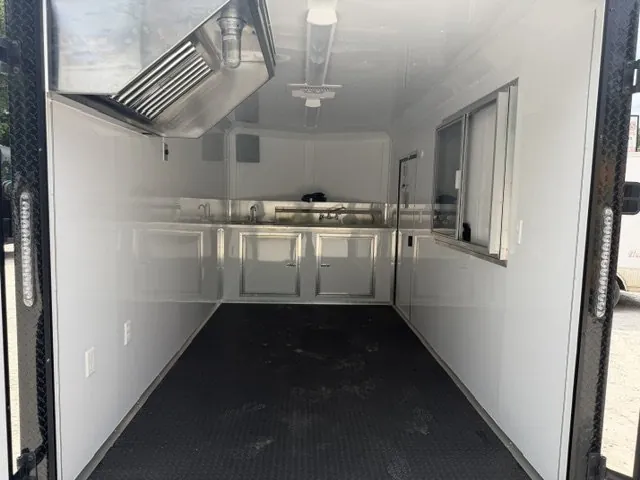
| Hot-line kitchen | 7x14 to 8x16 | Adds a hood vent, fire suppression, propane lines, fryer, flat-top and refrigeration. |
| Large kitchen or BBQ porch | 8.5x20 and up | Full cooking line, multiple windows, porch smoker deck, generator box and bathroom. |
Our food trailer cost guide shows typical pricing for each tier.
Small Food Trailers: 6x8 to 7x12
Small trailers suit coffee, shaved ice, lemonade, kettle corn, hot dogs and prepackaged food. They are light and easy to tow and park. A 6x8 food trailer on our lot lists about 1,200 lb empty with a 2,990 lb GVWR. The tradeoff is space: one person works comfortably, and two can feel tight.
Mid-Size Food Trailers: 7x12 to 8x16
This range covers a wide variety of menus, from sandwiches and tacos to burgers and fried foods. It leaves space for sinks, a prep area, refrigeration and, at the larger end, a full hot line under a hood. For example, a new 7x14 food trailer we have stocked lists about 2,120 lb empty with a 7,000 lb GVWR and comes with a hood, a sink package, A/C and a 50 amp electrical package. Two or three people can work inside a trailer this size.
Large Food Trailers: 8.5x20 and Up
Large trailers suit high-volume events, catering, BBQ operations with an outdoor smoker porch and businesses that want multiple service windows. They give a full crew room to work, but they need a heavy-duty tow vehicle, more parking space and a bigger electrical supply.
Other Sizing Factors
Power
Small trailers often run on a 30 amp package, while kitchens with A/C, refrigeration and multiple appliances generally need 50 amps. Add up the power draw of every appliance before you pick a package and a generator.
Water and plumbing
Hand washing and warewashing sinks, a water heater and fresh and grey water tanks take up space. Your local health department sets the requirements, so check them before you finalize the layout. The Georgia Department of Public Health's food service program lists the forms for mobile food service units and points you to your county environmental health office.
Towing and parking
Match the loaded trailer weight to your tow vehicle's capacity, and think about where you will operate. Festivals and brewery lots may have size limits, and tight downtown spots favor shorter trailers.
Workflow inside the trailer
Picture a busy service from start to finish. Orders come in at the window, food moves from cold storage to prep to the cooking line and back out the window. A good layout keeps that path short and keeps people from bumping into each other. If two people need to pass each other behind the line, the trailer needs to be wide and long enough for that.
Common sizing mistakes
- Buying the trailer first and trying to fit the equipment later
- Forgetting storage for dry goods, paper products and cleaning supplies
- Underestimating the electrical load of A/C and refrigeration in Georgia summers
- Choosing a trailer too large for the events and spots you plan to work
Room to grow
If you plan to expand your menu, a few extra feet now can save you from buying a second trailer later. Just weigh that against the extra cost, weight and parking space a larger trailer brings.
See Food Trailers in Person
Browse food trailers for sale or learn more about our concession trailers. Bring your menu and equipment list, and we will help you match it to a size.
Food trailers can be paid over time through traditional trailer financing, no credit check rent to own food trailers with 20% down for buyers in GA, FL, AL, TN, NC, MS, LA and TX, or lease-to-own through ClickLease, which starts with a soft credit pull. Delivery: $2.75 per road mile from our Jonesboro lot, $400 minimum. See /shipping for rates. Payment is made in person, and all sales are final.
Come see us at 8834 Tara Blvd, Jonesboro, GA 30236, just south of Atlanta. We are open Monday to Friday 9 AM to 5 PM and Saturday 9 AM to 4 PM. Call (770) 603-8511 or text (404) 383-8194 and tell us about your menu.
Frequently Asked Questions
What size food trailer do I need?
It depends on your menu and crew. Vending and drinks often fit in 6x8 to 7x12, prep-light menus in 7x12 to 8x12, cooked-to-order hot lines in 7x14 to 8x16 and large kitchens or BBQ porch builds in 8.5x20 and up.
Is a 7x14 big enough for a food trailer?
For many menus, yes. A 7x14 can hold a hood, sinks, A/C and refrigeration, with room for two or three people to work.
Do I need a hood in my food trailer?
If you fry or cook on a flat-top, you will typically need a vent hood with fire suppression. Check with your local health department and fire marshal.
How much power does a food trailer need?
Small vending trailers often use a 30 amp package. Kitchens with A/C, refrigeration and several appliances generally need 50 amps.
Can you deliver a food trailer?
Yes. Delivery: $2.75 per road mile from our Jonesboro lot, $400 minimum. See /shipping for rates.