
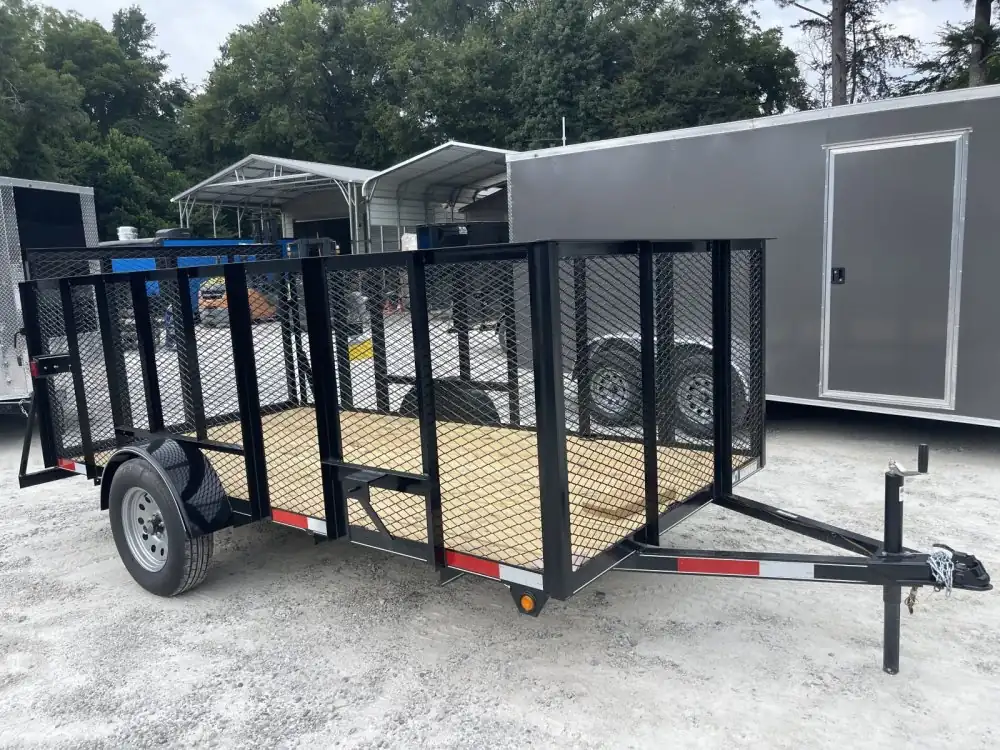
A plain utility trailer with low rails is great for mowers and equipment. Load it with leaves, brush or loose mulch, though, and you will spend half the trip watching your load in the mirror. That is where a utility trailer with mesh sides comes in. The sides add height around the deck so bulky, light material stays on the trailer.
Here is how mesh sides work, how the common heights compare and when you are better off with open rails.
What Mesh Sides Are
Mesh sides are open mesh panels built up from the trailer's side rails. They let air pass through, which keeps the trailer from catching wind like a solid wall, while holding in loose material. On the trailers we stock, they come in two common heights: 24 inches and 48 inches (4 feet).
Mesh Side Options on Our Lot
| New trailer | Mesh height | GVWR | Listed empty weight |
|---|---|---|---|
| 6x10 single axle | 24 inches | 2,950 lb | 800 lb |
| 6x12 single axle | 24 inches | 2,950 lb | 800 lb |
| 6x12 single axle | 48 inches | 2,950 lb | 850 lb |
| 6x12 tandem axle | 24 inches | 7,000 lb | see listing |
| 6.5x14 tandem axle | 24 inches | 7,000 lb | 1,350 lb |
The single axle units also have a pressure-treated wood floor and a 4-foot rear gate. Compare current units on our utility trailers page.
24-Inch Mesh Sides: The All-Around Choice
Two-foot sides are tall enough to keep bagged mulch, pine straw, small brush, trash cans and yard waste on the deck, while staying low enough to reach over to load and unload by hand. They also give you a solid place to strap hand tools and trimmers. For a lawn care route or a homeowner who does a mix of jobs, 24-inch sides are a practical middle ground.
4-Foot Mesh Sides: For Leaves and Brush
Four-foot sides roughly double the height of the load you can carry. That matters most for fall leaf cleanups, storm debris, brush, branches and light bulky items. The trade-offs are that you cannot easily reach over them, they add a little weight (850 lb listed vs 800 lb for the 24-inch 6x12) and they catch more wind on the highway.
Do Taller Sides Let You Carry More Weight?
No. Mesh sides add volume, not capacity. The GVWR stays the same: on a single axle 6x12, about 2,150 lb of payload with 24-inch sides and about 2,100 lb with 4-foot sides. Leaves and brush are light, so you will run out of room before weight. Mulch, soil and wet debris are heavier than they look, and a tall load of them can go past the rating. If you regularly haul heavy material, look at a tandem axle model with a 7,000 lb rating or a dump trailer.
When Open Rails Make More Sense
- You mainly haul mowers, ATVs or equipment and want to load from the sides.
- You carry long items such as lumber or pipe that hang over the sides.
- You want the lightest trailer possible.
Many lawn crews keep an open-rail trailer for equipment and use a mesh-side trailer for cleanups. Our utility trailer buying guide covers sizes and axles.
Keep the Load on the Trailer
Even with mesh sides, loose material can blow out the top at highway speed. Cover leaves, mulch and debris with a tarp or cargo net, and strap larger items. Material that comes off a trailer is a hazard to drivers behind you and can bring a ticket. Commercial haulers can find the federal standard in the FMCSA cargo securement rules.
Mesh Sides for Georgia Lawn Care Routes
Around metro Atlanta, the busiest months for a mesh-side trailer are fall leaf season and spring cleanups, with storm debris in between. A crew that bags leaves can get by with 24-inch sides; a crew that hauls loose leaves and brush piles will fill 4-foot sides on most jobs. If you also mow all summer, a mesh-side trailer still carries a mower; just make sure the gate works as a ramp for your machine.
Caring for Mesh Sides
- Clear wet leaves and debris out of the mesh and off the wood deck after each job so the floor can dry.
- Look over the welds and corners every few months, especially after loading with a skid steer or tractor.
- Touch up scraped paint to keep rust from spreading.
What to Check in Person
- Gate: make sure the rear gate works smoothly and latches. A 4-foot gate doubles as a ramp for mowers.
- Mesh welds: look at where the mesh panels meet the rails and corners.
- Tie-down points: count where you can hook straps and nets.
- Height in storage: 4-foot sides need more clearance in a garage or carport.
- Lights and wiring: hook up and test them before you leave.
Paying over time? We offer traditional trailer financing, no credit check rent to own on new standard trailers with 15% down for buyers in Georgia and 20 other states, and lease-to-own through ClickLease, which starts with a soft credit pull and is available in all 50 states. See our trailer financing options for the details.
Come see us at 8834 Tara Blvd, Jonesboro, GA 30236, just south of Atlanta. We are open Monday to Friday 9 AM to 5 PM and Saturday 9 AM to 4 PM. Call (770) 603-8511 or text (404) 383-8194 Bring a list of what you haul and we will show you mesh-side and open-rail trailers side by side.
Frequently Asked Questions
Are mesh sides worth it on a utility trailer?
Yes, if you haul leaves, brush, mulch or yard waste. They keep light, bulky loads on the deck. If you mostly haul equipment, open rails are lighter and easier to load from the side.
Should I get 2-foot or 4-foot mesh sides?
Two-foot sides suit mixed work and are easy to reach over. Four-foot sides suit leaf cleanups, brush and storm debris where you need volume.
Do mesh sides increase how much a utility trailer can carry?
No. They add volume, not weight capacity. The GVWR stays the same, so heavy material can still overload the trailer.
How much does a 6x12 utility trailer with 4-foot mesh sides weigh?
Our new single axle 6x12 with 48-inch mesh sides lists 850 lb with a 2,950 lb GVWR, for about 2,100 lb of payload.