
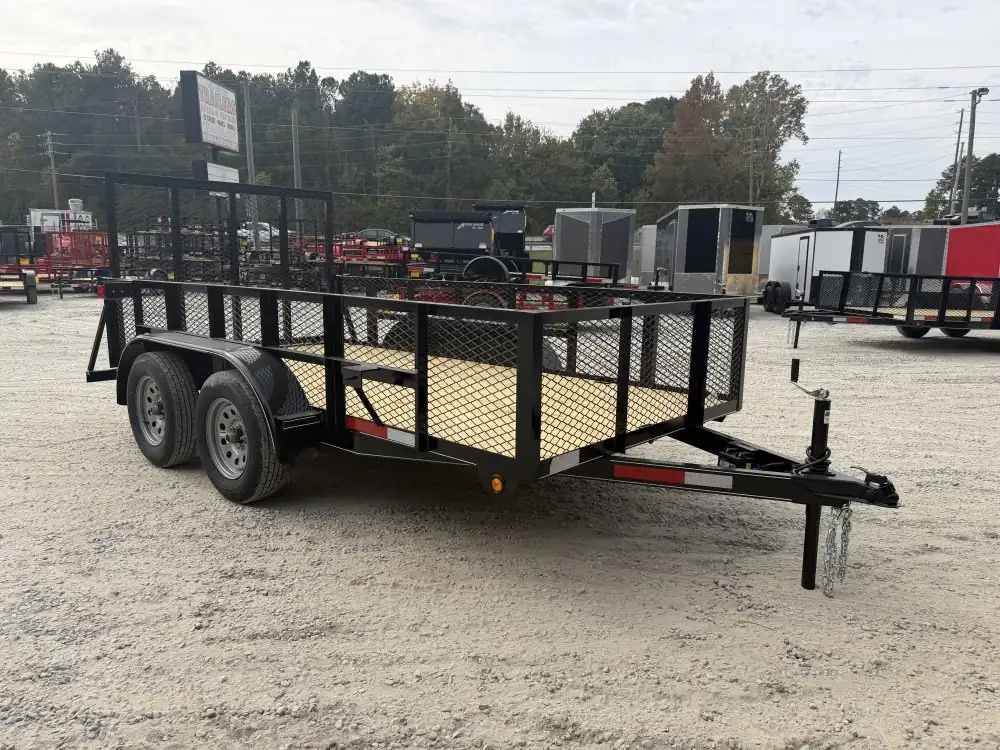
Two trailers can share the same deck size and still be very different to own. A 6x12 on one axle and a 6x12 on two axles look alike from the side mirror, but they carry different loads, tow differently and need different upkeep. Here is a plain comparison of single axle vs tandem axle trailers, with real numbers from our lot, so you can decide which one you need.
What the Terms Mean
A single axle trailer has one axle with one wheel on each side. A tandem axle trailer, also called a dual axle trailer, has two axles mounted close together, with two wheels on each side. Each axle has its own weight rating, and together with the frame, tires and coupler, those ratings set the trailer's GVWR.
Real Numbers From Our Lot
| Trailer | Axles | Empty weight | GVWR |
|---|---|---|---|
| 6x12 utility | Single | About 800 lb | 2,950 lb |
| 6.5x14 utility with 2-foot mesh sides | Dual | About 1,350 lb | 7,000 lb |
| 7x16 utility | Two 3,500 lb | About 1,820 lb | 7,000 lb |
| 6x12 enclosed, 6'6" interior | Tandem | About 1,800 lb | 7,000 lb |
For comparison, our trailer FAQ lists a typical 6x12 single axle enclosed trailer at about 1,200 lb and a 7x14 tandem axle enclosed trailer at about 2,000 lb. Weights vary by brand and build.
The Case for a Single Axle Trailer
- Lighter. Less empty weight means more of your tow vehicle's capacity goes to cargo, and smaller SUVs and pickups can pull it.
- Lower cost. One axle, two tires and two hubs generally cost less to buy and maintain.
- Easy to move by hand. A light single axle trailer can often be pushed into a garage or around a driveway.
- Simple upkeep. Fewer tires, bearings and brakes to check.
Single axle trailers fit loads like one mower, a few pieces of furniture, mulch, yard waste and small equipment.
The Case for a Tandem Axle Trailer
- More capacity. Two axles carry more weight. On our lot, the jump from a single axle 6x12 utility at 2,950 lb GVWR to a dual axle 6.5x14 at 7,000 lb GVWR more than doubles the rating.
- More stable. Four tires spread the load and help the trailer track straighter at highway speed.
- Smoother ride. Two axles share bumps, so the trailer bounces less, especially when empty.
- A margin for flats. If one tire blows, the other tire on that side can carry the trailer while you slow down and pull off. Replace the tire before you continue.
- Room to grow. If your loads get heavier or your business grows, a tandem gives you room.
The trade-offs: more empty weight, more tires and bearings to maintain, and a trailer that is harder to move by hand. Tandem trailers also scrub their tires a little in tight turns.
Upkeep Differences
A tandem axle trailer has twice the tires, hubs and bearings of a single axle trailer, so routine checks take a little longer. Keep all four tires the same size, load range and pressure, since a mismatched tire carries more or less than its share. Check that the trailer sits level when hitched. A nose-high or nose-low tandem trailer puts more weight on one axle and wears those tires faster. On a single axle trailer, the two tires carry the whole load, so a slow leak or worn tire matters even more.
Brakes and the 3,000 lb Line
Brakes are one of the biggest practical differences. In Georgia, a trailer needs brakes when its gross weight is over 3,000 lb, according to the Georgia Department of Public Safety. Many light single axle utility trailers are rated under that line, at 2,950 lb GVWR. Most tandem axle trailers are rated well above it and come with electric brakes on at least one axle, which means you need a brake controller in the tow vehicle. Our chapter on brake controls explains how they work.
Single vs Tandem Axle at a Glance
| Single axle | Tandem axle | |
|---|---|---|
| Capacity | Lower | Higher |
| Empty weight | Lighter | Heavier |
| Highway stability | Good when loaded correctly | Steadier, especially with heavy loads |
| Tires and bearings | Two | Four |
| Brakes | Often none on light models | Usually electric brakes |
| Moving by hand | Easier | Harder |
How to Decide
- Add up your heaviest regular load. Include tools, fuel and anything else you carry. If it is close to a single axle trailer's payload, step up to a tandem.
- Check your tow vehicle. Make sure its towing capacity covers the loaded trailer, and that it can run a brake controller if you go tandem.
- Think about distance. Short trips around town favor a single axle. Regular highway runs favor a tandem.
- Think about storage. If you need to push the trailer into a tight spot by hand, a single axle is easier.
- Plan for the next few years. If your loads may grow, the extra capacity of a tandem can save you from buying twice.
Common Picks
- Homeowner hauling mulch, a mower and furniture: single axle 5x10, 6x10 or 6x12 utility.
- Lawn crew or contractor with heavier loads: tandem axle 6.5x14 or 7x16 utility.
- Weekend cargo and moving: single axle enclosed 5x8 to 6x12.
- Daily contractor or business use: tandem axle enclosed 6x12, 7x14 or 7x16.
You can compare both styles on our utility trailers and enclosed trailers pages.
Paying over time? We offer traditional trailer financing, no credit check rent to own on new standard trailers with 15% down for buyers in Georgia and 20 other states, and lease-to-own through ClickLease, which starts with a soft credit pull and is available in all 50 states. Call or text and we will walk you through each one.
Come see us at 8834 Tara Blvd, Jonesboro, GA 30236, just south of Atlanta. We are open Monday to Friday 9 AM to 5 PM and Saturday 9 AM to 4 PM. Call (770) 603-8511 or text (404) 383-8194 Come look at single and tandem axle trailers side by side.
Frequently Asked Questions
Is a tandem axle trailer better than a single axle?
Not for everyone. A tandem axle carries more weight, tracks more steadily and rides smoother. A single axle is lighter, costs less and is easier to move by hand, which suits lighter loads.
How much weight can a single axle trailer carry?
It depends on the axle and build. A new single axle 6x12 utility trailer on our lot weighs about 800 lb with a 2,950 lb GVWR, which leaves about 2,150 lb of payload.
Do tandem axle trailers need brakes?
In Georgia, a trailer needs brakes when its gross weight is over 3,000 lb. Most tandem axle trailers are rated above that and come with electric brakes, which need a brake controller in the tow vehicle.
Are tandem axle trailers harder to back up?
Many drivers find a tandem axle trailer steadier and easier to control when backing, because it reacts a little more slowly to steering input than a short single axle trailer.