
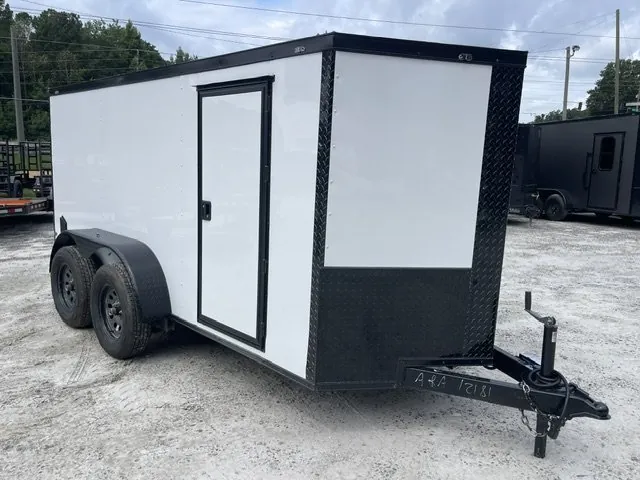
Backing up a trailer is the skill that makes many new owners nervous. The trailer seems to go the opposite way from where you steer, small corrections turn into big swings and there is always someone watching. The good news is that backing up is a learnable skill, not a talent. Once you understand why the trailer moves the way it does, a little practice makes it routine.
Why Backing a Trailer Feels Backward
The trailer pivots at the hitch ball. When you reverse and turn the top of the steering wheel to the right, the back of your vehicle moves right, which pushes the hitch right and swings the rear of the trailer to the left. In other words, with your hands in the usual position, you steer opposite to where you want the trailer to go. That is why many drivers use one simple trick.
The Hand-on-the-Bottom Trick
Put one hand at the bottom of the steering wheel, at the six o'clock position. Now move your hand in the direction you want the back of the trailer to go:
- Move your hand to the left, and the trailer goes left.
- Move your hand to the right, and the trailer goes right.
This takes the mental flip out of the equation. Keep your movements small. A quarter turn of the wheel makes a big difference once the trailer starts to angle.
Before You Start Backing
- Adjust your mirrors so you can see both sides of the trailer and the ground behind it. Extended towing mirrors help with wide trailers.
- Get out and look. Walk the path you plan to back into and check for posts, low branches, ditches and soft ground.
- Use a spotter when you can. Agree on hand signals first, and make sure the spotter stays where you can see them in a mirror.
- Roll the windows down and turn the radio off so you can hear.
How to Back a Trailer in a Straight Line
- Line up the vehicle and trailer straight, with the wheels pointed straight ahead.
- Back up slowly, at idle speed if possible.
- Watch both mirrors. If you see more of the trailer in one mirror, the trailer is drifting toward that side.
- Make a small correction by moving your hand at the bottom of the wheel away from the side the trailer is drifting toward, then return the wheel to center as soon as the trailer straightens.
- If it gets away from you, stop, pull forward to straighten out and start again.
How to Back a Trailer Around a Corner
Backing into a driveway, campsite or loading area usually means a turn. The key is setup:
- Pull past the opening. Stop with the trailer's rear axle a little past the spot you want to back into.
- Start the turn. With your hand at the bottom of the wheel, move it toward the opening so the trailer begins to angle that way.
- Follow the trailer. Once the trailer is angled, turn the wheel back the other way so your vehicle follows the trailer into the turn.
- Straighten out. As the trailer lines up with the spot, straighten the wheel and back in.
Watch the angle between your vehicle and the trailer. If it gets too sharp, you risk jackknifing, where the trailer folds toward the vehicle and can damage the trailer, tongue or bumper. Stop, pull forward and reset before it gets that far.
Shorter Trailers Move Faster
It surprises many people, but a short trailer is harder to back than a long one. The shorter the distance from the hitch to the trailer axle, the faster the trailer reacts to steering. A small 5x8 or 5x10 utility trailer can swing sharply with a tiny correction, while a 7x16 or 7x20 responds more slowly and gives you time to adjust. If you are learning on a small trailer, make extra small movements.
Practice Drills That Build Confidence
Find an empty parking lot on a quiet morning and set up a few cones or empty boxes:
- Straight line: back between two rows of cones about 12 feet apart.
- 90-degree turn: back around a corner into a parking space.
- Offset: back into a lane to the left or right of your starting lane.
- Blind side: practice backing to the passenger side, where you cannot see as well.
Twenty minutes a few times is more useful than one long session. The commercial driver's study guide on the Georgia Department of Driver Services manuals page also covers backing and other skills for combination vehicles.
Common Mistakes to Avoid
- Backing too fast. Slow gives you time to see and correct.
- Oversteering. Big wheel movements lead to big swings.
- Waiting too long to correct. Small, early corrections are easier than large, late ones.
- Not getting out to look. "Get out and look" is a habit worth keeping.
More Towing Basics
Backing up is easier when the trailer is hooked up and balanced correctly. Our guide to connecting your trailer to a tow vehicle walks through the hookup, and our guide for first-time trailer drivers covers driving on the road. For more safety habits, see Towing 101: towing safety.
Come see us at 8834 Tara Blvd, Jonesboro, GA 30236, just south of Atlanta. We are open Monday to Friday 9 AM to 5 PM and Saturday 9 AM to 4 PM. Call (770) 603-8511 or text (404) 383-8194 and ask us any towing questions when you pick up your trailer.
Frequently Asked Questions
Which way do I turn the wheel to back up a trailer?
Put your hand at the bottom of the steering wheel and move it in the direction you want the back of the trailer to go. Move left to go left and right to go right.
Why is a small trailer harder to back up?
The shorter the distance from the hitch to the trailer axle, the faster the trailer reacts to steering. Small trailers swing quickly, so use very small corrections.
How do I avoid jackknifing when backing a trailer?
Back up slowly and watch the angle between the vehicle and the trailer. If it gets sharp, stop, pull forward to straighten out and try again.
Should I use a spotter when backing a trailer?
Yes, when one is available. Agree on hand signals first and keep the spotter where you can see them in your mirror.
How can I practice backing up a trailer?
Use an empty parking lot and cones or boxes. Practice straight-line backing, 90-degree turns, offsets and backing to the passenger side in short sessions.