
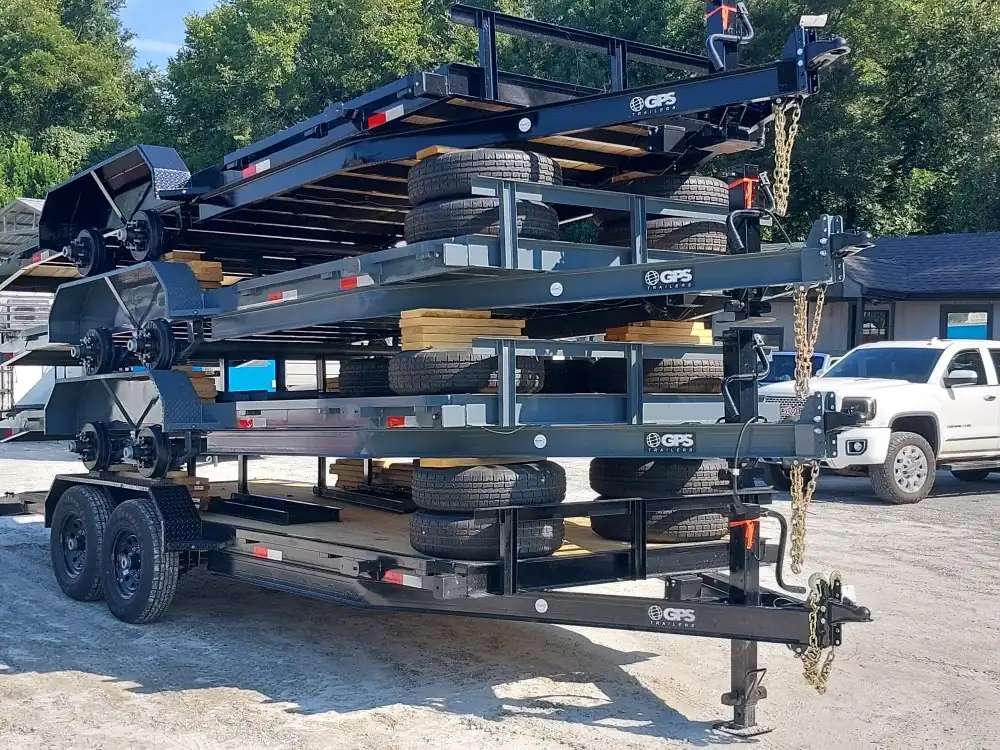
Once you start shopping for a bigger trailer, you will hear two terms over and over: bumper pull and gooseneck. Both describe where and how the trailer connects to the truck. That one difference changes how much weight you can carry, how the rig handles, which truck you need and what you will spend. Here is a plain comparison of gooseneck vs bumper pull trailers so you can decide which style fits your work.
What Is a Bumper Pull Trailer?
A bumper pull trailer, also called a tag-along or drag-along trailer, connects behind the truck. Its coupler closes over a hitch ball on a ball mount that slides into a receiver hitch bolted to the truck frame under the rear bumper. Most utility, enclosed, dump, car hauler and equipment trailers are bumper pull. On our lot, that includes 7x20 and 7x24 equipment trailers rated at 14,000 lb and 16,000 lb GVWR.
What Is a Gooseneck Trailer?
A gooseneck trailer has a long neck that arches over the tailgate and couples to a ball mounted in the bed of a pickup, over or just ahead of the rear axle. Goosenecks are common on long flatbeds, large equipment trailers and some livestock and car hauling setups. A fifth wheel is a close cousin that uses a kingpin and a coupling plate instead of a ball, and you see it mostly on large campers.
Gooseneck vs Bumper Pull at a Glance
| Bumper pull | Gooseneck | |
|---|---|---|
| Hitch location | Receiver behind the rear bumper | Ball in the truck bed over the rear axle |
| Tow vehicle | Cars, SUVs, vans and pickups, depending on rating | Pickup trucks only |
| Typical weight on the hitch | Roughly 10 to 15 percent of the loaded trailer | Roughly 15 to 25 percent of the loaded trailer |
| Handling | Good on lighter loads; more prone to sway as weight rises | Steadier with heavy loads; tighter turning |
| Truck bed | Stays free | Hitch ball sits in the bed |
| Hitch setup | Standard receiver and ball mount | Bed-mounted gooseneck hitch |
Why Goosenecks Handle Heavy Loads Better
On a bumper pull, the hitch sits several feet behind the truck's rear axle. Tongue weight acts like a lever, lifting the front of the truck slightly and taking weight off the steering axle. As trailers get heavier, that lever effect grows, and so does the chance of sway in crosswinds or when a truck passes.
A gooseneck puts its weight right over or ahead of the rear axle. The truck carries the load more evenly, steering stays planted, and the trailer is far less likely to sway. The pivot point inside the bed also lets the trailer turn more sharply before the trailer and truck contact each other.
Why Bumper Pulls Are Still the Most Common Choice
- Works with more vehicles. Any car, SUV or truck with a properly rated receiver can tow a bumper pull trailer.
- Simpler hitch. A receiver, ball mount and ball are all you need, and many trucks come with a receiver from the factory.
- Bed stays open. Your pickup bed is free for tools, materials and passengers' gear.
- Lower cost. A bumper pull trailer and hitch generally cost less than a gooseneck of similar size.
- Easy to hook up. Many owners find it easier to see a rear hitch ball with a backup camera.
For most utility, landscape, enclosed and dump trailers, a bumper pull is plenty. The hitch types are covered in more depth in our chapter on types of hitches.
When a Gooseneck Makes Sense
- You regularly haul loads near the top of the 14,000 to 16,000 lb range or beyond.
- You want a long flatbed deck of 25 feet or more for multiple machines.
- You tow long distances on the highway, where stability counts most.
- You already have a heavy-duty pickup and do not need the bed for cargo.
Keep in mind that a gooseneck requires a bed-mounted hitch in the truck. We do not install hitches, so plan that work with a hitch shop before you buy.
Weight Ratings Matter More Than Style
Whichever style you choose, the numbers have to line up. Your truck's towing capacity, the hitch rating, the ball rating and the trailer's GVWR must all cover the loaded trailer. Gooseneck pin weight also counts against your truck's payload, since it sits in the bed. Our guide to what GVWR means on a trailer explains how to check each number.
Heavier rigs also bring rules into play when they are used for business. The Georgia Department of Public Safety explains that a truck and trailer combination used in business with a GVWR of 10,001 lb or more is a commercial motor vehicle for most safety regulations, and that a commercial driver's license applies at 26,001 lb and above.
A Simple Way to Decide
- What is your heaviest regular load? If it fits comfortably on a 14,000 or 16,000 lb bumper pull with margin, start there.
- What will you tow with? If it is not a pickup, it has to be bumper pull.
- Do you need the truck bed? If yes, bumper pull keeps it free.
- How far and how often? Long, heavy highway runs favor a gooseneck.
Most of our customers, from landscapers to contractors moving a skid steer, find a bumper pull equipment trailer covers their work. You can compare current ratings on our equipment trailers page.
Paying over time? We offer traditional trailer financing, no credit check rent to own on new standard trailers with 15% down for buyers in Georgia and 20 other states, and lease-to-own through ClickLease, which starts with a soft credit pull and is available in all 50 states. See our trailer financing options for the details.
Come see us at 8834 Tara Blvd, Jonesboro, GA 30236, just south of Atlanta. We are open Monday to Friday 9 AM to 5 PM and Saturday 9 AM to 4 PM. Call (770) 603-8511 or text (404) 383-8194 Tell us what you haul and what you drive, and we will help you choose.
Frequently Asked Questions
What is the difference between a gooseneck and a bumper pull trailer?
A bumper pull trailer hitches to a ball on a receiver behind the truck's rear bumper. A gooseneck hitches to a ball mounted in the pickup bed over the rear axle, which lets it carry heavier loads with better stability.
Is a gooseneck safer than a bumper pull?
With heavy loads, a gooseneck is generally more stable because its weight sits over the truck's rear axle, which reduces sway. A properly loaded and rated bumper pull is safe for most everyday hauling.
Can an SUV pull a gooseneck trailer?
No. A gooseneck needs a hitch ball mounted in a pickup truck bed. SUVs, vans and cars can only tow bumper pull trailers, within their rated capacity.
Does A&A Center Trailers install gooseneck hitches?
No. We do not install hitches of any kind, so have your hitch set up by a hitch shop before you pick up your trailer.