Before you serve your first plate from a food trailer in Georgia, you need permits from the health department. The process is not complicated once you know the order, but doing it out of order, such as buying a trailer before you know what your county requires, can cost you time and money. Here is how a Georgia food trailer permit works, based on guidance from the Georgia Department of Public Health (DPH).
How Georgia Defines a Mobile Food Business
Georgia treats a food trailer as part of a mobile food service establishment. That establishment includes two parts: your mobile unit, which is the trailer or truck, and your base of operation, also called a commissary. The county where your base of operation sits is your county of origin, and that is where you apply for permits.
Step 1: Check Local Ordinances
DPH advises starting with the local rules in your county of origin. Some cities and counties restrict or do not allow mobile food units, and those rules are separate from health department requirements. Check with your city or county planning and zoning office before you invest.
Step 2: Secure a Base of Operation
Every mobile unit needs its own base of operation. According to DPH, it is where you:
- Dump wastewater from the trailer
- Refill fresh water tanks
- Store and prepare food
- Wash, rinse and sanitize dishes and utensils too large for the trailer's sinks
- Clean and service the unit
The permit holder must return to the base daily, so pick a location within a reasonable distance of where you plan to sell. DPH says the minimum at a base is a dump station or mop sink, a handwashing sink and a potable water tap, and your menu and equipment determine what else is needed. Two separate permit holders may not share a base's space or equipment.
Can the base be at your home? DPH says it depends. Food service cannot operate in a private home or living space, but if local zoning allows it and you have an area completely separate from the home, such as an outbuilding, the health department may allow it.
Step 3: Apply for Permits in Your County of Origin
You apply for two permits at your county health department: one for the base of operation and one for each mobile unit. DPH lists what to submit:
- Your menu
- A to-scale diagram or sketch of the base of operation and the trailer layout
- Pictures of the trailer, inside and outside
- Any fees set by the county
DPH recommends getting these permits sorted before you invest money. In practice, many buyers start the conversation with their county while their trailer layout is still on paper.
Step 4: Plan the Trailer Around the Requirements
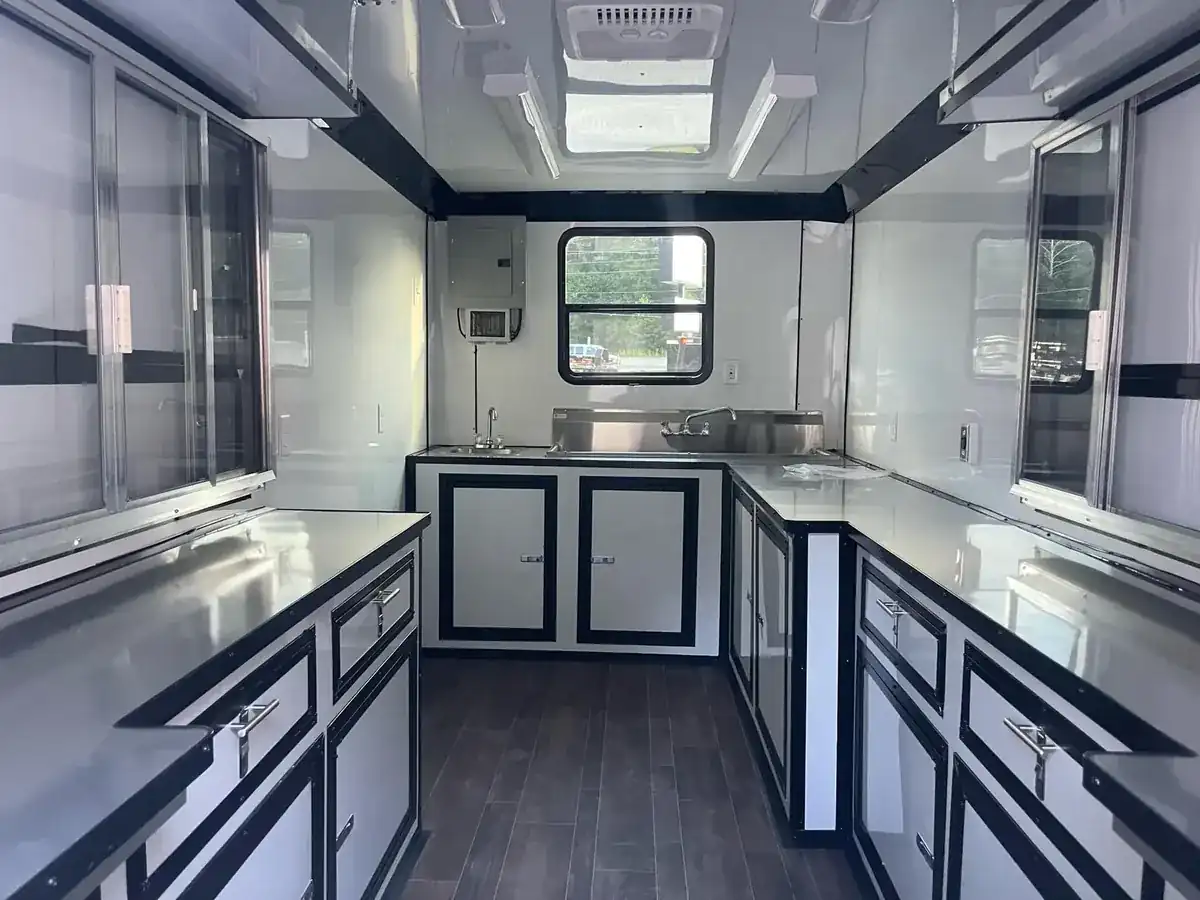
Your menu drives your equipment, and your county reviews the plan. Common items include sinks for handwashing and dishwashing, fresh and gray water tanks, refrigeration and, for cooking menus, a hood vent and fire suppression. Plan review and approval are up to your county health department, so get its requirements first and then tell your builder which equipment and options you need.
Our custom concession trailers can include propane gas lines, generator boxes, electrical packages, serving windows, fire suppression, sinks and hand wash stations, fryers, hood exhaust vents, grills, prep tables, bathrooms and refrigeration. After you place a deposit, you get a virtual design session with our in-house CAD artist, so you can see the layout in 3D before production begins. That layout is useful for the to-scale diagram the county asks for.
Step 5: Operating in Other Counties
This changed in 2023. Under HB 1443, signed in May 2022, a mobile food service establishment permitted in its county of origin has that permit recognized in all other Georgia counties beginning January 1, 2023. You still need to apply for an authorization to operate from the health department in each outside county before you sell there.
- The outside county verifies that your permits are active and in good standing.
- Counties may charge an administrative fee for authorization.
- DPH says there is no inspection for authorization, but your unit may be inspected at any time in counties where it operates.
So if your base is in Clayton County and you want to vend in Fulton or Henry, you apply for authorization in each of those counties, not a full new permit.
Where to Find the Official Rules
Georgia's food service rules are Chapter 511-6-1. The DPH mobile food FAQ covers the base of operation, permits and outside counties, and the DPH food service page links to rules, forms and county contacts. Your county environmental health office has the final word on your plan.
Other Licenses to Plan For
The health permit is one piece. Depending on your city and county, you may also need a business license, a fire inspection for cooking equipment and propane, and state tax registration. Ask your city or county what applies before your first event.
A Simple Order of Operations
- Check local ordinances in your county of origin.
- Line up a base of operation.
- Talk to your county health department about your menu and equipment.
- Design the trailer around those requirements.
- Submit permit applications for the base and the trailer.
- Apply for authorization in each outside county you plan to serve.
For a closer look at budgets, see our food trailer cost guide, and for local answers about commissaries and counties, see food trailers in Atlanta.
Used kitchens on our lot are listed with our used food trailers for sale.
Food trailers can be paid over time three ways: traditional trailer financing, no credit check rent to own with 20% down for buyers in Georgia, Florida, Alabama, Tennessee, North Carolina, Mississippi, Louisiana and Texas, and lease-to-own through ClickLease, which starts with a soft credit pull and is available in all 50 states. Equipment installed on the trailer can be included in a rent-to-own contract.
Come see us at 8834 Tara Blvd, Jonesboro, GA 30236, just south of Atlanta. We are open Monday to Friday 9 AM to 5 PM and Saturday 9 AM to 4 PM. Call (770) 603-8511 or text (404) 383-8194 Bring your menu and we will help you plan a layout your county can review.
Frequently Asked Questions
Do I need a commissary for a food trailer in Georgia?
Yes. Georgia requires each mobile food unit to have its own base of operation, also called a commissary, where you dump wastewater, refill water, store and prep food and clean the unit. You must return to it daily.
Where do I apply for a food trailer permit in Georgia?
Apply at the health department in your county of origin, which is the county where your base of operation is located. You need a permit for the base and one for each mobile unit.
Can I sell from my food trailer in other Georgia counties?
Yes. Since January 1, 2023, your county of origin permit is recognized statewide, but you must apply for an authorization to operate in each outside county before selling there. Counties may charge an administrative fee.
Can my food trailer base of operation be at my house?
It depends on local zoning and your setup. Food service cannot operate in living space, but the health department may allow a separate area, such as an outbuilding, if local rules permit it.