
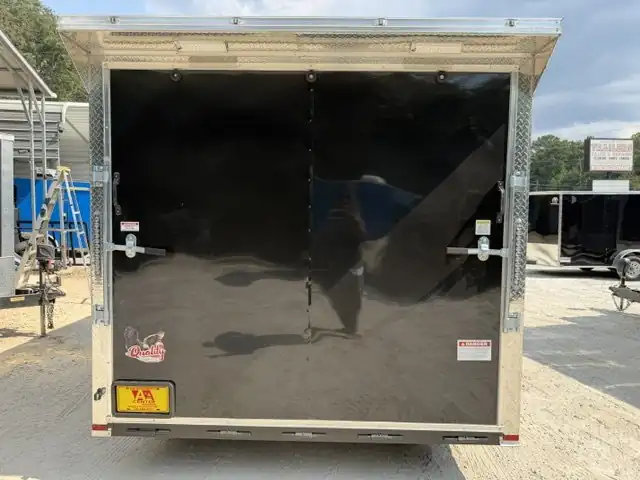
Every job site needs a place to spread out plans, take a call out of the noise, keep the laptop dry and lock up the paperwork at night. A construction office trailer gives you that space and moves with you to the next project. Many contractors around Atlanta build theirs from an enclosed trailer, which can be towed with a pickup and set up in a corner of the site.
Here is how to plan one, from size to power to the small details that make it a good place to work.
What a Construction Office Trailer Is
An office trailer starts as an enclosed trailer shell and is finished inside as a workspace. At A&A Center Trailers, mobile office trailers can be customized with features such as extended tongues, fiber optic cable doors, upgraded LED interior lighting and electrical, a work bench or desk, climate control, insulation, and built-in cabinets and shelving. You can choose a ready-to-go unit or have one built to your specifications on our mobile office trailer page.
Step 1: Decide Who Uses It and How
- One superintendent with a desk and plan table: a compact trailer can work.
- A small team meeting daily: plan for seating, a table and room to move.
- Office plus tool storage: split the trailer with a wall, a desk area up front and storage in the back.
- Inspections and client walk-throughs: think about a clean entry, lighting and a place to lay out drawings.
Step 2: Pick a Size
Width and interior height shape how the space feels. A 7-foot-wide trailer fits a desk along one wall with an aisle. An 8.5-foot-wide trailer, such as the 8.5x24 enclosed trailers on our lot with a 7-foot interior height, gives room for desks on both sides or a meeting table. Longer trailers let you divide office and storage.
Bigger is not always better. A longer, wider trailer needs a heavier tow vehicle and more room to place on a tight site. Our enclosed trailer size guide walks through the common sizes.
Step 3: Plan Power
List everything you will plug in: laptops, printers, lights, chargers, a small refrigerator, a coffee maker and the A/C or heat. That list drives the electrical package and the number of outlets. Decide whether you will run on shore power from the site's temporary service or on a generator, and plan the cord or generator location so it is safe and out of traffic.
Step 4: Climate Control and Insulation
Georgia job sites are hot in summer and can be cold on winter mornings. Air conditioning, heating and insulation make the trailer usable year-round and protect electronics and paperwork. Insulation also helps cut the noise from equipment outside.
Step 5: Desks, Storage and Data
- A built-in desk or work bench along one wall.
- Cabinets and shelving for binders, plans, PPE and supplies.
- A plan table or wall rail for drawings.
- A fiber optic cable door if you will run a wired connection.
- LED lighting bright enough to read drawings.
Step 6: Security and Placement
Lockable doors are the start. Add a coupler lock and plan where the trailer will sit: on firm, level ground, out of the path of trucks and equipment and close enough to power. Leveling jacks or stabilizers make the floor steady when people walk around inside.
Step 7: Safety on Site
An office trailer is part of the job site, so treat it that way: clear walkways, a fire extinguisher, a first aid kit and safe cord routing. OSHA's construction industry resources are a good place to check site safety basics.
Owning an Office Trailer vs a Modular Office
Owning an office trailer means you can move it yourself to the next project instead of scheduling a pickup and drop-off, and you can lay it out the way your crew works. It is also easier to resell than a fixed building. The trade-off is that you handle towing, setup and upkeep.
Questions to Answer Before You Order
- How many people will work inside at once?
- What will you plug in, and will you use shore power or a generator?
- Do you need storage for tools or materials in the same trailer?
- What truck will move it between sites?
- Do you need a wired internet connection?
Build Time and Getting It to Your Site
Custom builds can be ready as fast as 2 weeks, and most take about 4. You can pick up at our Jonesboro lot, or ask about delivery; see our shipping page for rates.
Paying for an Office Trailer
Mobile office trailers are specialty builds. They can be paid over time with traditional trailer financing, no credit check rent to own with 20% down for buyers in Georgia, Florida, Alabama, Tennessee, North Carolina, Mississippi, Louisiana and Texas (higher-priced builds can still qualify with a larger down payment), or lease-to-own through ClickLease, which starts with a soft credit pull and is available in all 50 states.
A few things to know before you visit: payment is made in person at our lot, and all sales are final, so take your time walking through the trailer and asking questions before you sign.
Come see us at 8834 Tara Blvd, Jonesboro, GA 30236, just south of Atlanta. We are open Monday to Friday 9 AM to 5 PM and Saturday 9 AM to 4 PM. Call (770) 603-8511 or text (404) 383-8194 Tell us how your crew will use the space and we will help you lay it out.
Frequently Asked Questions
What is a construction office trailer?
It is an enclosed trailer finished inside as a workspace, with options such as a desk, lighting, electrical, climate control, insulation, cabinets and shelving, so it can be towed from job site to job site.
What size office trailer do I need?
A 7-foot-wide trailer fits a desk along one wall for one or two people. An 8.5-foot-wide trailer gives room for desks on both sides or a meeting table, and longer trailers can split office and storage.
Can an office trailer have air conditioning?
Yes. Climate control options such as air conditioning and heating, plus insulation, can be added to our mobile office trailers.
How long does it take to build an office trailer?
Custom builds can be ready as fast as 2 weeks, and most take about 4 weeks.