
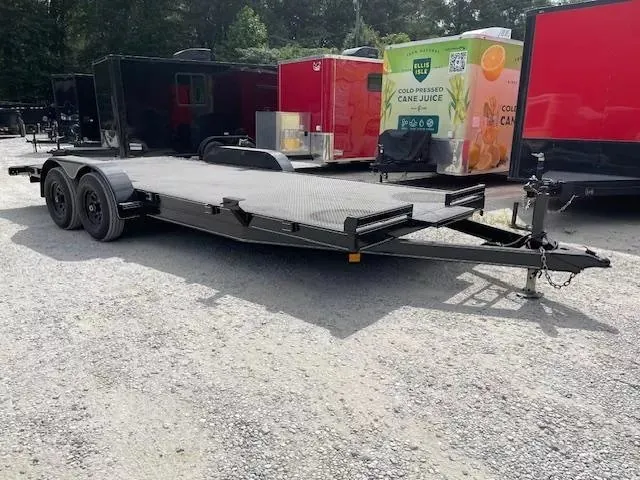
If every car you haul starts, runs and drives, you can load it under its own power. But project cars, auction finds, race cars and vehicles with a dead battery or locked brakes do not always cooperate. That is where a winch on your car hauler earns its keep. This guide explains when a winch makes sense, how to size one, where it mounts and how to use it safely.
Do You Need a Winch on Your Car Hauler?
You probably need a winch if you:
- Haul non-running vehicles, such as project cars or salvage
- Buy vehicles at auctions or from private sellers where condition is unknown
- Haul race cars or low cars that are hard to drive up ramps
- Load alone, without a second person to steer while others push
If you only haul your own running vehicle, a winch is a convenience rather than a necessity. Even so, many owners add one because a single dead battery can turn a quick load into an afternoon of pushing.
Where the Winch Mounts
A winch needs a solid mounting point at the front of the trailer deck. Some car haulers are built with one. For example, the 7x20 steel floor car hauler we have stocked comes with a winch mounting plate, a removable driver-side fender for door clearance and 5-foot slide-in ramps. Its listing notes that you can ask about adding a winch or spare tire. Do not bolt a winch to a thin deck board or a light crossmember; the pull of a loaded winch is substantial.
How to Size a Car Trailer Winch
Winches are rated by line pull, the force they can pull on the first layer of cable on the drum. A common rule of thumb is to choose a winch rated at about 1.5 times the weight of the heaviest vehicle you plan to load. That margin covers:
- The incline of the ramps and deck
- Flat tires, locked brakes or a vehicle stuck in park
- Loss of pulling power as more cable wraps onto the drum
Also check that your car hauler's payload covers the vehicle. The 7x20 steel floor car hauler mentioned above lists about 2,000 lb empty with a 7,000 lb GVWR, which leaves roughly 5,000 lb for the car, winch and gear.
Steel Cable or Synthetic Rope?
Steel cable resists abrasion and holds up well around sharp edges, but it is heavy and stores energy that can whip if it snaps. Synthetic rope is lighter, easier to handle and less dangerous if it breaks, but it needs protection from heat, sharp edges and UV. Either works for a car hauler; choose based on how often you winch and how you store the trailer.
How to Winch a Car Onto a Trailer Safely
- Set up on level ground with the trailer hooked to the tow vehicle and the tow vehicle's parking brake set.
- Line up the car straight with the ramps. Put the car in neutral and have someone steer if possible.
- Attach to a solid point on the car's frame or a recovery point, never to the bumper, suspension arms or steering parts. Use a strap or bridle if needed.
- Keep people clear of the cable line and the area behind the car. A damper or heavy blanket over the line adds a margin of safety.
- Winch slowly and steadily. Stop if the car drifts off line, and re-align before continuing.
- Stop with the car in position so about 60% of the vehicle's weight sits ahead of the trailer axles.
The Winch Is Not a Tie-Down
Once the car is in place, secure it with proper tie-downs before you move. A winch holds the vehicle while loading, but its cable and gears are not designed to restrain a car through braking, bumps and turns. Strap the vehicle at all four corners using wheel straps or frame points, and set the car's parking brake.
The federal FMCSA cargo securement rules, written for commercial haulers, set requirements for securing vehicles on trailers, and they are a good standard to follow even for personal use.
Electric or Hand Winch?
An electric winch runs off a battery, usually the tow vehicle's or a dedicated battery on the trailer, and pulls a car up with the push of a button or remote. It is the common choice for anyone who loads non-running cars often. A hand winch costs less and needs no wiring, but cranking a heavy car up an incline is slow, hard work. If you plan to winch more than now and then, electric is worth the wiring.
Winch Care
- Inspect the cable or rope for kinks, frays or broken strands before each use.
- Keep the winch covered when not in use.
- Check the wiring and battery connections if your winch is electric.
- Re-spool the line neatly under light tension after use.
Shop Car Haulers in Jonesboro
Browse our car hauler trailers or narrow the search to 7x20 car haulers. For straps, ramps and other gear, visit our trailer parts counter. Regular trailers are picked up at our Jonesboro lot, and payment is made in person.
Paying over time? We offer traditional trailer financing, no credit check rent to own on new standard trailers with 15% down for buyers in Georgia and 20 other states, and lease-to-own through ClickLease, which starts with a soft credit pull and is available in all 50 states. See our trailer financing options for the details.
Come see us at 8834 Tara Blvd, Jonesboro, GA 30236, just south of Atlanta. We are open Monday to Friday 9 AM to 5 PM and Saturday 9 AM to 4 PM. Call (770) 603-8511 or text (404) 383-8194 and ask about winch options on the car hauler you are considering.
Frequently Asked Questions
Do I need a winch on a car hauler?
If you haul non-running cars, auction vehicles or race cars, or you load alone, a winch makes loading safer and easier. For running vehicles only, it is a convenience.
What size winch do I need for a car trailer?
A common rule of thumb is a winch rated at about 1.5 times the weight of the heaviest vehicle you plan to load, to cover ramp angle, flat tires and locked brakes.
Where do I attach a winch strap on a car?
Attach to a solid frame point or recovery point. Never hook to the bumper, suspension arms or steering components.
Can I use the winch to hold the car during transport?
No. Use the winch to load the car, then secure it at all four corners with proper tie-downs before you drive.
Do your car haulers come with winch mounting?
The 7x20 steel floor car hauler we have stocked includes a winch mounting plate, and you can ask us about adding a winch.