
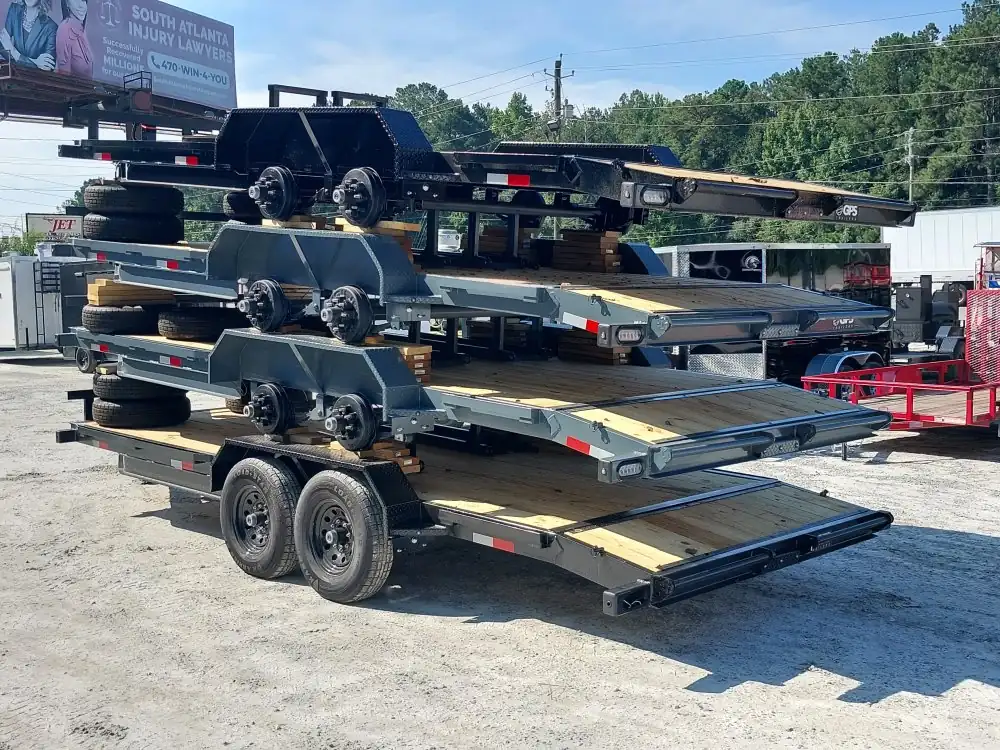
Equipment trailers in the 7x20 class are commonly rated at 14,000 lb or 16,000 lb GVWR. At first glance, the 16,000 lb trailer looks like it carries 2,000 lb more. In practice, the payload gap is often smaller, because the heavier-rated trailer usually weighs more empty. Here is how to compare a 14,000 vs 16,000 lb GVWR equipment trailer and choose the one that fits your machine and your truck.
Start With Payload, Not GVWR
GVWR is the most the trailer and its load may weigh together. Payload is what is left for your machine:
GVWR minus empty weight equals payload.
Here is how that works out on new equipment trailers on our lot:
| Trailer | Empty weight | GVWR | Payload |
|---|---|---|---|
| 7x20 with two 7,000 lb axles, pressure-treated wood deck and ramps | About 2,775 lb | 14,000 lb | About 11,225 lb |
| 7x20 heavy equipment trailer, wood deck, tandem axle, ramps | About 3,720 lb | 16,000 lb | About 12,280 lb |
| 7x24 heavy equipment trailer | About 4,350 lb | 16,000 lb | About 11,650 lb |
The 16,000 lb 7x20 carries about 1,055 lb more than the 14,000 lb 7x20, not 2,000 lb. The 16,000 lb 7x24 adds deck length but, because of its extra weight, carries only about 425 lb more than the 14,000 lb 7x20. Our post on what GVWR means explains the terms in more detail.
Step 1: Weigh What You Haul
Add up everything on the deck:
- The machine's operating weight from its spec sheet
- Attachments, such as a bucket, forks, auger or breaker
- A second machine, if you carry two
- Fuel, tools, chains and binders
Then leave a margin. Running a trailer at its limit every day is hard on tires, bearings and brakes. If your load is within a few hundred pounds of the 14,000 lb trailer's payload, the 16,000 lb trailer gives you breathing room.
Step 2: Check Your Truck
A heavier-rated trailer does nothing for you if your truck cannot handle it. Check these in your owner's manual:
- Towing capacity must cover the loaded trailer.
- Tongue weight, roughly 10 to 15 percent of the loaded trailer, must stay within the hitch and truck limits. At 16,000 lb, that can mean 1,600 lb or more on the hitch.
- Gross combined weight rating must cover the truck, people, fuel, gear and loaded trailer together.
- Hitch, ball mount and ball must each be rated for the load.
Many three-quarter-ton trucks are well matched to a 14,000 lb trailer. A fully loaded 16,000 lb trailer often calls for a one-ton or larger truck.
Step 3: Know the Licensing Lines
Weight ratings also decide which rules apply when you use the rig for work. The Georgia Department of Public Safety explains that a truck and trailer used in business with a GVWR of 10,001 lb or more is a commercial motor vehicle for most safety regulations, and that a commercial driver's license and drug and alcohol testing also apply at 26,001 lb and above.
That 26,001 lb line is where the 2,000 lb difference can matter. Pairing a truck with a 10,000 lb GVWR with a 16,000 lb trailer puts the combination at 26,000 lb. The same truck with a heavier GVWR, or the same trailer with a heavier truck, can push the combination over the line. Add up your truck's GVWR and the trailer's GVWR before you buy, and check the CDL manual from Georgia DDS.
Step 4: Think About Deck Length
If your machine fits a 20-foot deck, a 7x20 gives you the most payload per pound of trailer. Step up to a 7x24 when you need to carry a machine plus attachments, a second compact machine or longer equipment. Keep the heaviest part of the load slightly ahead of the axles for proper tongue weight.
Loading Tips for Either Rating
A higher rating does not make up for poor loading. Park on firm, level ground with the trailer hitched before you load. Drive the machine up the ramps slowly and straight, with a spotter to the side. Center it side to side, set its brake, lower any bucket or attachment to the deck and chain it at all four corners. Recheck the chains after the first few miles.
Which One Fits?
| Your situation | Consider |
|---|---|
| Compact tractor, small skid steer or mini excavator with room to spare | 14,000 lb 7x20 |
| Load within a few hundred pounds of 11,000 lb | 16,000 lb 7x20 |
| Machine plus attachments or a second small machine | 16,000 lb 7x24 |
| Three-quarter-ton truck and staying under combined limits | 14,000 lb |
| One-ton or larger truck, heavy loads daily | 16,000 lb |
Other Things to Compare
- Ramps. Check ramp length, width and rating against your machine's track or tire width.
- Deck. Pressure-treated wood decks are common on these trailers and give good grip.
- Tie-down points. Look for stake pockets, D-rings or a rub rail that let you chain at all four corners.
- Brakes. Trailers in this range have brakes, so your truck needs a brake controller.
For a wider look at trailer weights, see equipment trailer weights. To compare current ratings side by side, visit our equipment trailers page.
Paying over time? We offer traditional trailer financing, no credit check rent to own on new standard trailers with 15% down for buyers in Georgia and 20 other states, and lease-to-own through ClickLease, which starts with a soft credit pull and is available in all 50 states. See our trailer financing options for the details.
Come see us at 8834 Tara Blvd, Jonesboro, GA 30236, just south of Atlanta. We are open Monday to Friday 9 AM to 5 PM and Saturday 9 AM to 4 PM. Call (770) 603-8511 or text (404) 383-8194 Bring your machine specs and truck ratings, and we will help you run the numbers.
Frequently Asked Questions
What is the difference between a 14,000 and 16,000 lb equipment trailer?
The 16,000 lb trailer has a higher weight rating but usually weighs more empty. On our lot, a 14,000 lb 7x20 carries about 11,225 lb of payload and a 16,000 lb 7x20 carries about 12,280 lb, a difference of about 1,055 lb.
Can a three-quarter-ton truck pull a 16,000 lb trailer?
Some can, but many three-quarter-ton trucks are better matched to a 14,000 lb trailer. Check your truck's towing capacity, tongue weight limit and gross combined weight rating against the loaded trailer.
Do I need a CDL for a 16,000 lb equipment trailer?
For business use in Georgia, a commercial driver's license applies when the combination is rated 26,001 lb or more. Add your truck's GVWR and the trailer's GVWR, and check the Georgia DDS CDL manual.
How much can a 7x20 equipment trailer carry?
On our lot, a new 7x20 rated at 14,000 lb GVWR weighs about 2,775 lb and carries about 11,225 lb. A 7x20 rated at 16,000 lb GVWR weighs about 3,720 lb and carries about 12,280 lb.