Walk onto any trailer lot and you will see a dozen shapes and sizes. Some are open, some are boxed in, some tilt their bed into the air, and some are built out as rolling businesses. If you are shopping for the first time, the names can blur together. This guide sorts the common types of trailers into plain groups, explains what each one is built to do and points out the questions that narrow your choice.
One note before we start: you will hear "cargo trailer" and "enclosed trailer" used for the same thing. At A&A Center Trailers, a cargo trailer is an enclosed trailer.
The Two Big Families: Open and Enclosed
Almost every trailer falls into one of two families. Open trailers have a deck with low sides or no sides at all. They are lighter, easier to load from any angle and usually cost less. Enclosed trailers have walls, a roof and lockable doors. They protect cargo from rain, sun and theft, and they double as storage when parked.
From there, each type is shaped by what it carries.
Enclosed (Cargo) Trailers
An enclosed trailer is a box on wheels with a rear ramp door or barn doors and, on most models, a side door. Common sizes run from 5x8 and 6x12 up to 7x16 and 8.5-foot-wide models of 20 feet and longer. Contractors use them as rolling tool rooms, small businesses haul inventory and event gear, and families move furniture or carry motorcycles and ATVs.
What to compare: width, length, interior height, single or tandem axles and door style. You can browse current sizes on our enclosed trailers page.
Utility Trailers
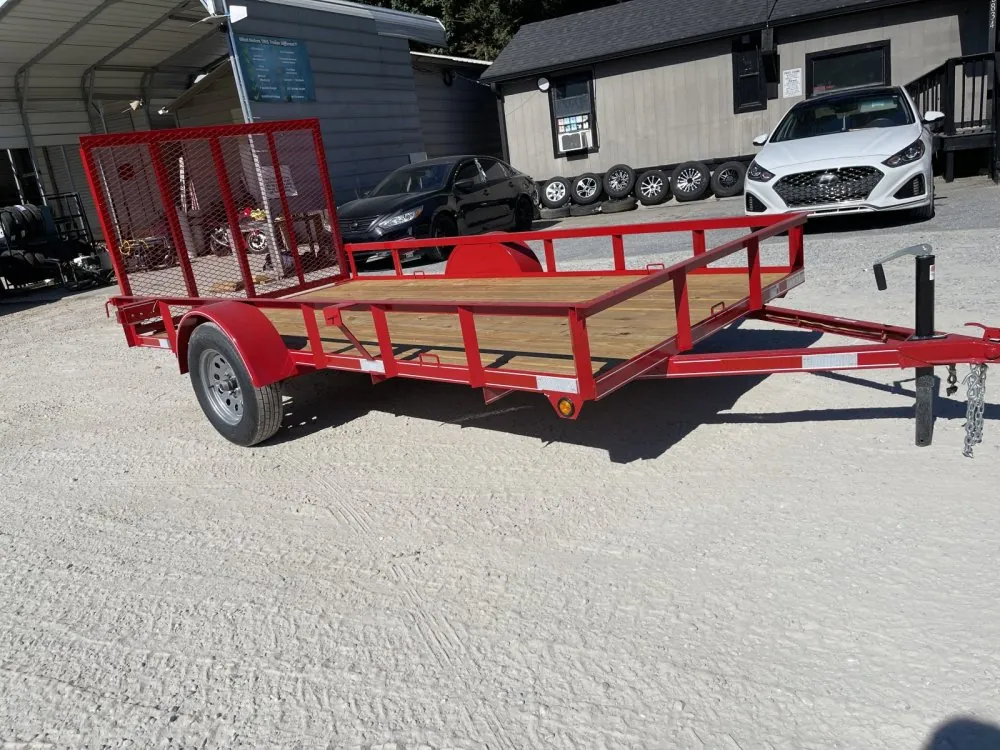
A utility trailer is an open deck, usually with a wood floor, low rails and a rear gate that folds down as a ramp. They are the everyday choice for mowers, mulch, brush, furniture and weekend projects. Popular sizes include 5x10, 6x10, 6x12 and 7x16.
Some utility trailers add mesh or solid sides for leaves and light bulky loads. Lighter single-axle models suit small SUVs and pickups, while tandem-axle models carry more and track better on the highway. See the sizes we stock on our utility trailers page.
Dump Trailers
A dump trailer has a steel bed with solid sides and a hydraulic hoist that lifts the front of the bed so the load slides out the back. They haul gravel, dirt, roofing tear-off, demolition debris and yard waste, and they save hours of shoveling.
Dump trailers are heavier than utility trailers of the same size. A 6x10 dump trailer on our lot weighs about 2,180 lb empty, and a 7x14 with 4-foot sides weighs about 5,140 lb. That means a capable truck is part of the purchase. Browse our dump trailers to compare side heights and weight ratings.
Equipment Trailers
Equipment trailers are heavy-duty open decks built for machines: skid steers, compact tractors, mini excavators and similar loads. They have stronger frames, heavier axles and sturdy rear ramps. Our 7x20 equipment trailers carry ratings of 14,000 lb and 16,000 lb.
The key number on an equipment trailer is payload, which is the weight rating minus the empty trailer. Always compare it to your machine's operating weight plus attachments. See our equipment trailers for current ratings.
Car Haulers
Car haulers are open trailers sized to carry a vehicle. A typical model is 7 feet wide and 20 feet long, with slide-in ramps, a removable fender on one side so you can open the door after loading, and stake pockets or D-rings for tie-downs. Decks come in wood or steel.
If you need weather protection or security for a show car or race car, an 8.5-foot-wide enclosed trailer can serve as an enclosed car hauler.
Specialty and Business Trailers
Many enclosed trailers are built out for a specific job. Common examples include:
- Food and concession trailers with sinks, electrical packages, serving windows and, for cooking menus, hood vents and fire suppression.
- Pet grooming trailers with a tub, water tanks, a dryer, air conditioning and a grooming work area.
- Mobile offices, contractor trailers and race trailers set up for a particular workflow.
These start as an enclosed trailer shell, then get finished walls, plumbing, electrical and equipment.
A Quick Way to Compare Trailer Types
| Type | Suited to | Key spec to check |
|---|---|---|
| Enclosed (cargo) | Tools, inventory, moving, motorcycles and ATVs | Interior height and door size |
| Utility | Lawn equipment, yard waste, furniture | Deck size and gate style |
| Dump | Gravel, dirt, debris, roofing | Side height and GVWR |
| Equipment | Skid steers, tractors, compact machines | Payload and ramp strength |
| Car hauler | Cars, trucks, side-by-sides | Deck length, width and tie-down points |
| Specialty | Food, grooming and other mobile businesses | Water, power and layout |
How to Choose the Right Type
Start with three questions:
- What will you haul most often? Buy for the regular load, not the rare one.
- Does it need protection? If the cargo cannot get wet or must be locked up, go enclosed.
- What will tow it? Your vehicle's towing capacity has to cover the trailer plus the load.
Then check the trailer's GVWR, its maximum loaded weight. In Georgia, a trailer with a gross weight of more than 3,000 lb needs brakes, according to the Georgia Department of Public Safety's motor carrier FAQ. Most tandem-axle trailers come with brakes for that reason.
See the Types Side by Side
The fastest way to understand the differences is to stand next to them. We keep enclosed, utility, dump, equipment and car hauler trailers on our lot, and regular trailers are picked up right here in Jonesboro.
Paying over time? We offer traditional trailer financing, no credit check rent to own on new standard trailers with 15% down for buyers in Georgia and 20 other states, and lease-to-own through ClickLease, which starts with a soft credit pull and is available in all 50 states. Call or text and we will walk you through each one.
Come see us at 8834 Tara Blvd, Jonesboro, GA 30236, just south of Atlanta. We are open Monday to Friday 9 AM to 5 PM and Saturday 9 AM to 4 PM. Call (770) 603-8511 or text (404) 383-8194 and tell us what you need to haul.
Frequently Asked Questions
What are the main types of trailers?
The common types are enclosed (cargo) trailers, utility trailers, dump trailers, equipment trailers, car haulers and specialty trailers such as food and pet grooming trailers. Each is built around a different kind of load.
Is a cargo trailer the same as an enclosed trailer?
Yes. The two names describe the same thing: a trailer with walls, a roof and lockable doors.
Which trailer type should a first-time buyer look at?
Start with what you will haul most often. Open everyday loads point to a utility trailer, while cargo that must stay dry or locked up points to an enclosed trailer.
What is the difference between a utility trailer and an equipment trailer?
Utility trailers are lighter open trailers for everyday loads. Equipment trailers have heavier frames, axles and ramps rated for machines, with GVWRs such as 14,000 or 16,000 lb.
Do all trailers need brakes in Georgia?
No. Georgia requires brakes when the trailer and its load weigh more than 3,000 lb. Many light single-axle trailers fall under that, while most tandem-axle trailers come with brakes.