
Loading a car on a trailer is the easy part. Keeping it exactly where you put it for the whole trip is what takes care. A car that shifts even a few inches can change how the trailer handles, damage the vehicle or come loose entirely.
Here is how to tie down a car on a trailer the right way, whether you are moving a project car across town or taking a race car to the track.
What You Need
- Four tie-down straps or chains, rated for the job (more on ratings below)
- Wheel nets or wheel straps if you want to secure the car by its tires
- Axle straps if you plan to strap to the suspension or frame
- Wheel chocks
- A winch, helpful for cars that do not run
- Edge protectors for any strap that touches a sharp edge
Our trailer parts counter carries tie-downs and straps if you need to fill gaps.
Step 1: Hitch Up and Level the Trailer
Connect the trailer to the tow vehicle before loading, with the safety chains attached and the parking brake set on the tow vehicle. A level trailer loads straighter and keeps the tongue from lifting. Make sure the ramps are seated securely.
Step 2: Load and Position the Car
Drive or winch the car up slowly and centered. Have a spotter guide you. Position it so the trailer has proper tongue weight, which for most car haulers means the engine end sits slightly ahead of the trailer axles. A common target is about 10 to 15 percent of the total loaded weight on the tongue. If the tongue feels light, move the car forward.
Put the car in park (or in gear for a manual) and set the parking brake.
Step 3: Choose Your Tie-Down Method
Wheel Nets or Wheel Straps
These go over the tires and secure the car by its wheels, so the suspension can move naturally. They avoid contact with the body and frame, which makes them popular for classic and lowered cars.
Axle Straps
These loop around a solid axle or a strong suspension point and attach to a tie-down strap. They work well when wheel nets do not fit. Keep them away from brake lines, sway bar links and anything that can be crushed or cut.
Factory Tie-Down Points
Many vehicles have tie-down points or slots built into the frame. The owner's manual usually shows where they are. Federal cargo securement rules say tiedowns attached to a vehicle must use the mounting points designed for that purpose.
Step 4: Secure All Four Corners
- Attach the front straps first, pulling forward and out at an angle from each front corner to the trailer's stake pockets, D-rings or rub rail.
- Attach the rear straps, pulling backward and out from each rear corner.
- Cross or angle the straps so they resist movement side to side as well as front to back.
- Tighten evenly. Work around the car a little at a time. Do not crank one corner tight before the others.
- Secure the loose ends so they cannot flap, fray or get caught in a wheel.
If you used the winch to load the car, leave the winch strap attached as a backup, but do not count it as a tie-down.
How Strong Should the Straps Be?
Every strap and hook has a working load limit (WLL) printed on its label. The federal cargo securement rules in 49 CFR Part 393, Subpart I require the combined working load limit of all tiedowns to be at least half the weight of the cargo. For vehicles under 10,000 lb hauled commercially, they call for restraint at the front and rear with at least two tiedowns.
Those rules apply to commercial haulers, but they are a sound baseline for everyone. For a 4,000 lb car, your straps should add up to at least 2,000 lb of WLL. Four straps add margin. Remember that a strap is only as strong as its weakest part, including the hooks and the anchor point on the trailer.
Common Mistakes
- Strapping to body panels, bumpers or tie rods. They are not designed to hold the car.
- Using worn straps. Retire straps with cuts, fraying, burns or damaged hooks.
- Over-tightening. On a car strapped by the body or frame, cranking too hard can compress the suspension, and the straps can loosen as it settles.
- Loading too far back. A tail-heavy trailer is prone to sway.
- Forgetting loose items. Remove or secure anything inside the car that can fly around.
Check Again After You Start Moving
Straps settle and stretch. Stop within the first few miles and check every strap. Then check again at every fuel or rest stop. Look for loose straps, shifted wheels and anything rubbing.
Picking a Trailer for Hauling Cars
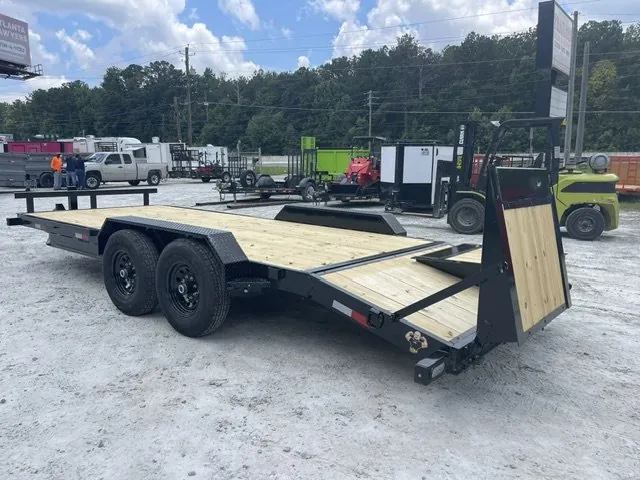
A good car hauler makes all of this easier. Look for a deck long enough for your vehicle, ramps with a gentle angle for low cars, stake pockets or D-rings in useful spots, and a winch plate. Browse our car hauler trailers for sale, or if you want weather protection and security, take a look at our enclosed car hauler trailers.
Come see us at 8834 Tara Blvd, Jonesboro, GA 30236, just south of Atlanta. We are open Monday to Friday 9 AM to 5 PM and Saturday 9 AM to 4 PM. Call (770) 603-8511 or text (404) 383-8194 and tell us what you need to haul.
Frequently Asked Questions
How many straps do you need to tie down a car on a trailer?
Use four, one at each corner. Federal rules for commercial hauling call for at least two tiedowns at the front and rear of vehicles under 10,000 lb, and four straps give you more control and a margin of safety.
Should I strap a car by the wheels or the frame?
Both work. Wheel nets let the suspension move naturally and avoid touching the body. Frame or axle straps work when wheel nets do not fit. Use factory tie-down points where the vehicle has them.
How tight should car tie-down straps be?
Tight enough that the car cannot shift, but not so tight that you compress the suspension. Tighten each corner evenly and check again after a few miles.
What strength straps do I need to haul a car?
The combined working load limit of all your tie-downs should be at least half the car's weight. For a 4,000 lb car, that means at least 2,000 lb of total working load limit.
Where should a car sit on a car hauler trailer?
Position it so the trailer has proper tongue weight, often about 10 to 15 percent of the total loaded weight. For many cars that means the engine end sits slightly ahead of the trailer axles.