
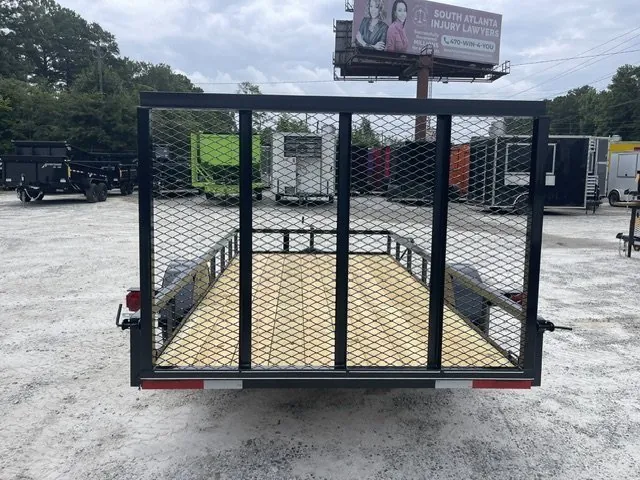
A utility trailer has low sides and no roof, so everything on the deck is exposed to wind, bumps and hard stops. A load that looks steady in the driveway can shift at the first turn or lift off at highway speed. Securing it properly takes a few extra minutes and keeps your cargo, and the drivers behind you, safe.
Start With the Right Placement
How you place the load matters as much as how you strap it:
- Heavy items forward. Put about 60% of the cargo weight ahead of the trailer axle. Too much weight behind the axle reduces tongue weight and can cause sway.
- Centered side to side. Keep the weight balanced between the left and right tires.
- Low and tight. Lay items flat where you can, keep the center of gravity low and pack pieces close together so they cannot slide into each other.
- Within the rating. Check the trailer's GVWR. A 6x12 utility trailer on our lot lists about 800 lb empty with a 2,950 lb GVWR, which leaves roughly 2,150 lb for cargo.
Our guide on loading your trailer properly and safely covers weight placement in more detail.
Pick the Right Tie-Downs
Most utility trailer loads are secured with ratchet straps. Look for the working load limit (WLL) printed on the strap's label, not just the break strength. The federal FMCSA cargo securement rules, written for commercial carriers, require the combined working load limit of the tie-downs to be at least half the weight of the cargo. That is a sound standard for anyone towing a trailer.
- Ratchet straps for most loads: mowers, appliances, furniture and boxed items.
- Cam buckle straps for light items that could be crushed by a ratchet.
- Chains and binders for heavy machines with tie-down points.
- Cargo nets and tarps for loose material and small items.
Replace any strap that is cut, frayed or sun-faded, or that has a damaged hook or ratchet.
Find Solid Anchor Points
Attach straps to the trailer's tie-down points, stake pockets or frame rails. Avoid hooking to thin side rails or the gate, which are not designed to hold the full pull of a strap. If your trailer has few anchor points, D-rings can be added. Our trailer parts counter carries tie-downs and straps for utility trailers.
Strap It Down Step by Step
- Place the load and check the weight balance.
- Run straps over or through the item at an angle, pulling it down and toward the anchor points.
- Use at least two straps on every item, crossing them where possible so the item cannot slide forward, back or sideways.
- Tighten until the item is snug and does not move when you push it. Do not over-tighten fragile items.
- Tie off or secure the loose tail of every strap so it cannot flap or unwind.
- Close and pin the rear gate, and make sure it is latched on both sides.
For mowers and other wheeled equipment, set the parking brake, then strap the frame at the front and rear. Do not rely on the wheels alone.
Tips for Common Utility Trailer Loads
Furniture and appliances
Stand tall items like refrigerators and dressers upright against the front rail, wrap them in moving blankets and strap them to the front and sides. Lay mattresses flat or strap them firmly against a tall item, since wind can lift a mattress like a sail.
Lumber and long items
Center long material on the deck, keep it within the trailer's length where possible and strap it at both ends. If anything extends past the back of the trailer, mark the end with a red or orange flag so drivers behind you can see it.
Boxes and bins
Stack heavier boxes on the bottom and toward the front, fill gaps so nothing can slide and run straps over the top of the stack, then cover with a cargo net.
Tarp Loose Material
Mulch, brush, leaves, sand and yard debris can blow out of an open trailer. Cover the load with a tarp or cargo net and strap the edges down so wind cannot catch them. Georgia drivers are responsible for keeping their load from falling or blowing onto the road, so cover anything that could escape.
Check It Before You Go and on the Way
- Walk around the trailer and push on each item before you leave.
- Check that the coupler, safety chains and lights are connected.
- Stop after the first few miles to re-check straps, since loads settle.
- Check again after any hard stop, rough road or long drive.
Common Mistakes
- Using bungee cords as the main tie-down. They stretch and let loads move.
- Strapping only one side of an item.
- Stacking heavy items on top of light ones.
- Leaving the gate unpinned or relying on it to hold the load.
- Loading too much weight behind the axle.
Shop Utility Trailers in Jonesboro
Looking for a trailer with the right size and tie-down points for your loads? Browse our utility trailers for sale. Regular trailers are picked up at our Jonesboro lot, and payment is made in person.
Paying over time? We offer traditional trailer financing, no credit check rent to own on new standard trailers with 15% down for buyers in Georgia and 20 other states, and lease-to-own through ClickLease, which starts with a soft credit pull and is available in all 50 states. Call or text and we will walk you through each one.
Come see us at 8834 Tara Blvd, Jonesboro, GA 30236, just south of Atlanta. We are open Monday to Friday 9 AM to 5 PM and Saturday 9 AM to 4 PM. Call (770) 603-8511 or text (404) 383-8194 and ask about straps and tie-downs while you are here.
Frequently Asked Questions
How many straps do I need for a utility trailer load?
Use at least two straps on each item and more for long or heavy items. Federal commercial rules call for tie-downs with a combined working load limit of at least half the cargo weight, which is a good guide for anyone.
Where should I put the weight on a utility trailer?
Place about 60% of the cargo weight ahead of the axle, centered side to side and as low as possible.
Can I use bungee cords to secure a trailer load?
Not as the main tie-down. Bungee cords stretch and let cargo shift. Use ratchet or cam buckle straps rated for the load.
How do I keep mulch or leaves from blowing out of my trailer?
Cover the load with a tarp or cargo net and strap down the edges so wind cannot get underneath.
Should I re-check straps during a trip?
Yes. Check them after the first few miles and after any hard stop or rough road, because loads settle and straps can loosen.