Two of the most common questions we hear at the lot are "Does this trailer need brakes?" and "Are running lights required?" The answers depend on weight, how you use the trailer and, for some rules, whether it is part of a business. Here is a plain-English look at Georgia trailer brake and light requirements.
This is a general guide, not legal advice. Laws change, so check the sources linked below or ask the Georgia Department of Public Safety if your situation is unusual.
When Does a Trailer Need Brakes in Georgia?
Georgia law (O.C.G.A. § 40-8-50) requires brakes on all wheels of every trailer with a gross weight of 3,000 lb or more. The Georgia Department of Public Safety FAQ puts it simply: if the gross weight of the trailer, meaning the trailer plus its load, is over 3,000 lb, it needs brakes.
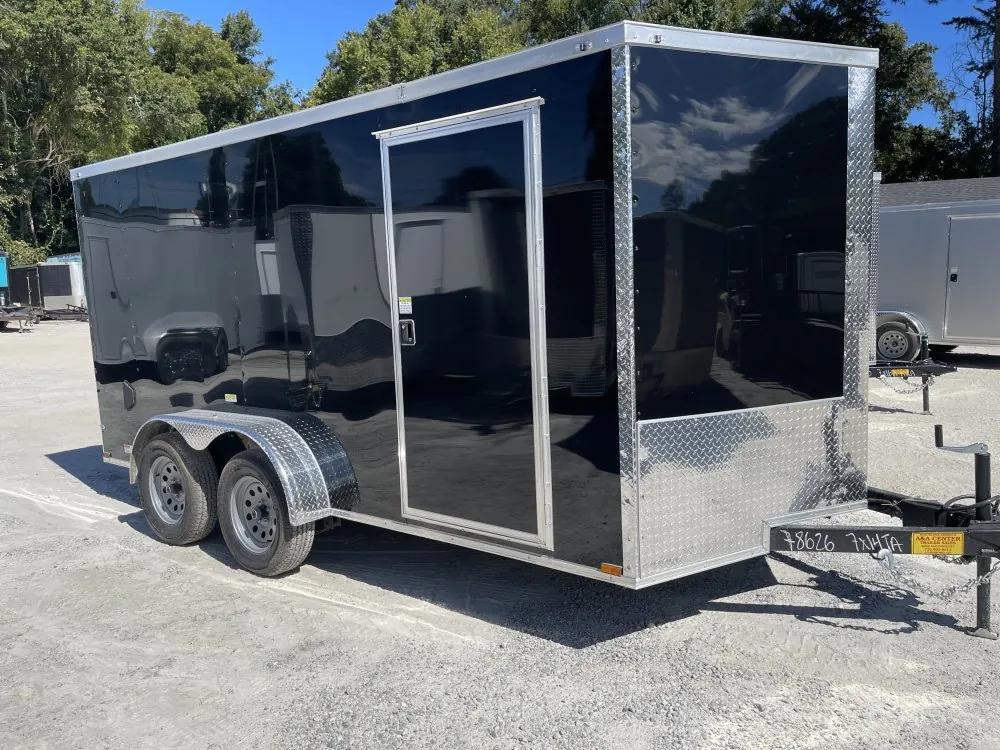
The key word is gross. A 7x14 enclosed trailer that weighs about 2,000 lb empty crosses 3,000 lb as soon as you put about 1,000 lb of cargo in it. That is a riding mower and some hand equipment, or a load of tools and materials.
Surge Brakes vs. Electric Brakes
Electric brakes are the most common setup on the trailers we sell. A brake controller in your vehicle sends power to the trailer brakes when you slow down. Our Towing 101 chapter on brake controls explains how controllers work.
Surge brakes are self-contained hydraulic brakes that apply when the trailer pushes against the tow vehicle as you slow. Georgia allows them within limits: the trailer cannot exceed 20,000 lb, its GVWR has to stay within set ratios of the tow vehicle's GVWR, and the brakes must apply automatically if the trailer breaks away. DPS notes that surge brakes are not legal in interstate commerce.
Breakaway Brakes
A breakaway system applies the trailer brakes automatically if the trailer separates from the tow vehicle. On electric-brake trailers it is a switch with a pull pin and cable, powered by a small battery on the trailer.
For vehicles and combinations over 10,001 lb GVWR used in business, Georgia DPS lists the required trailer brakes as service brakes on all wheels, a parking brake system, an emergency brake system and a breakaway braking system. The federal rule on breakaway brakes is 49 CFR 393.43.
Which Lights Does a Trailer Need?
Georgia's lighting rules are in Title 40, Chapter 8 of the state code. For a typical trailer, plan on:
- Taillights: two red taillights on the rear, lit whenever your headlights are on. This is what most people mean by running lights on a trailer.
- Stop lamps: brake lights that come on when you press the brake pedal.
- Turn signals: working left and right signals at the rear of the trailer.
- License plate light: a white light that makes the rear plate readable at night.
- Reflectors: red reflectors on the rear.
Wider Trailers
Trailers 80 inches or wider, which includes 8.5-wide enclosed trailers and many car haulers, typically carry additional clearance and side marker lamps. Federal rules for commercial vehicles in 49 CFR 393.11 list required lamps by trailer width.
How to Check Your Brakes and Lights
- Plug in and walk around. With a helper, test the taillights, brake lights, both turn signals and hazards.
- Check the plate light. It is the one most often burned out.
- Test the trailer brakes. Roll forward slowly and squeeze the manual lever on your brake controller. You should feel the trailer pull back.
- Check the breakaway battery. Many breakaway kits have a test button or charge indicator.
- Look at the wiring. Check for chafed wires under the trailer, corroded connectors and a loose ground wire, the most common cause of dim or flickering lights.
Our Chapter 6 on wiring and electrical covers connectors and troubleshooting.
Setting Up Your Brake Controller
Legal brakes only help if they are adjusted to the load. With the trailer hitched and loaded the way you will tow it:
- Drive slowly, around 20 to 25 mph, on a flat, empty road or lot.
- Squeeze the controller's manual lever all the way.
- If the trailer wheels lock, turn the gain down. If the stop feels weak, turn it up.
- Aim for firm braking just short of lockup.
- Readjust whenever the load changes a lot, such as empty versus full.
Why Trailer Lights Stop Working
Most trailer lighting problems come down to a few causes: a poor ground connection, corroded pins in the plug, a wire rubbed through under the frame, or a burned-out bulb. LED lights last longer and resist vibration, but they still depend on a good ground and clean connections. A few minutes with a test light and some contact cleaner fixes many problems.
Fixing Brake and Light Problems
Our trailer repair shop in Jonesboro handles wiring repair, brake and axle work and a free multi-point inspection. If you would rather do it yourself, our trailer parts counter stocks brake controllers, wiring harnesses and other common parts.
Quick Answers
- Light utility trailer, light load: lights and reflectors required; brakes once trailer plus load reach 3,000 lb.
- Tandem enclosed trailer: often over 3,000 lb loaded, so brakes on all wheels.
- Dump, equipment and car hauler trailers: almost always over 3,000 lb loaded; plan on brakes and a breakaway system.
- Business use over 10,001 lb combined GVWR: additional commercial vehicle rules apply.
Come see us at 8834 Tara Blvd, Jonesboro, GA 30236, just south of Atlanta. We are open Monday to Friday 9 AM to 5 PM and Saturday 9 AM to 4 PM. Call (770) 603-8511 or text (404) 383-8194 and tell us what you need to haul.
Frequently Asked Questions
Does my trailer need brakes in Georgia?
Georgia law requires brakes on all wheels of a trailer with a gross weight of 3,000 lb or more. Gross weight means the trailer plus its load.
Are surge brakes legal in Georgia?
Yes, within limits. Surge brakes can be used on trailers up to 20,000 lb that meet the weight ratio limits in O.C.G.A. 40-8-50 and apply automatically on breakaway. Georgia DPS notes they are not legal in interstate commerce.
Are running lights required on a trailer in Georgia?
Yes. Trailers need red taillights that are lit whenever your headlights are on, plus brake lights, turn signals, a license plate light and rear reflectors.
Do I need a breakaway kit on my trailer?
Business vehicles over 10,001 lb combined GVWR need a breakaway braking system under the rules Georgia DPS enforces, and surge-brake trailers must apply automatically on breakaway. Many trailers with electric brakes come with a breakaway kit.
Who can fix trailer brakes and lights near Atlanta?
Our shop at 8834 Tara Blvd in Jonesboro repairs trailer wiring, brakes and axles. Call (770) 603-8511.