From the road, an equipment trailer and a utility trailer can look like cousins. Both are open, flat and ready to load. But they are built for very different weights, and buying the wrong one either leaves you overloaded or pulling around far more trailer than your work needs.
Here is how equipment trailers and utility trailers differ, and how to decide which one fits the way you work.
The Short Answer
- Choose a utility trailer for mowers, ATVs, yard material, furniture, lumber and lighter loads, especially if you tow with an SUV or half-ton pickup.
- Choose an equipment trailer for skid steers, mini excavators, compact tractors and other heavy machines, and plan on a truck rated to pull the load.
How They Are Built
| Feature | Utility trailer | Equipment trailer |
|---|---|---|
| Typical use | Mowers, ATVs, yard work, home projects | Skid steers, excavators, tractors, heavy machines |
| Frame | Lighter frame, often with side rails | Heavier frame and crossmembers built for concentrated weight |
| Axles | Single or tandem, often 3,500 lb axles or lighter | Tandem axles with heavier ratings |
| Loading | Ramp gate or fold-down gate | Heavy-duty rear ramps, sometimes a dovetail |
| Brakes | Often none on light single-axle units | Usually brakes on both axles |
| Tie-downs | Rails and corner points | Stake pockets, D-rings and heavy anchor points |
Weight Ratings Tell the Real Story
The biggest difference is GVWR, the most the trailer may weigh fully loaded. Utility trailers on our lot are commonly built on lighter axles and carry ratings that suit mowers and home projects. Equipment trailers are a different class. Recent units on our lot include 7x20 equipment trailers rated at 14,000 lb GVWR and 7x20 and 7x24 Southern Utility heavy equipment trailers rated at 16,000 lb GVWR.
To find your real payload, subtract the trailer's empty weight from its GVWR. A 7x20 equipment trailer with a 14,000 lb GVWR that weighs about 2,800 lb empty can carry roughly 11,000 lb of equipment.
Deck, Ramps and Loading
Utility Trailers
Most utility trailers load from a rear ramp gate that folds down, which works well for mowers, ATVs and wheelbarrows. Side rails help keep loose material and smaller items in place.
Equipment Trailers
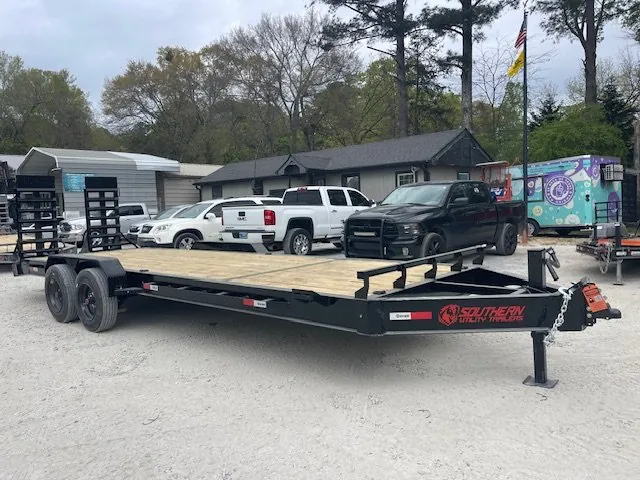
Equipment trailers use heavy-duty ramps built to take the weight of a tracked or wheeled machine. Some recent 7x20 units on our lot have had Mack Daddy ramps, a ramp style built for heavy loading. Wood decks are common and give tracks good grip. Deck lengths on the equipment trailers we have carried have run from 8 feet up to 24 feet.
Brakes and the Law
Georgia law requires brakes on all wheels of a trailer with a gross weight of 3,000 lb or more, counting the trailer plus its load. Nearly every equipment trailer crosses that line once it is loaded. A light utility trailer carrying a push mower may not, but a tandem utility trailer with a zero-turn and a full set of hand equipment can. The Georgia Department of Public Safety FAQ also explains when a truck and trailer used for business count as a commercial vehicle under the safety rules.
What Will Tow It?
Your tow vehicle often makes the decision for you.
- A single-axle utility trailer pairs with many SUVs and half-ton pickups.
- A tandem utility trailer with a heavy mower is commonly pulled by a half-ton or three-quarter-ton pickup.
- A loaded equipment trailer in the 14,000 to 16,000 lb range generally calls for a heavy-duty pickup rated for that weight, with a brake controller and a hitch rated to match.
Check your truck's towing capacity, hitch rating and GCWR before you choose.
Which One Fits Your Work?
Homeowners and Weekend Projects
A utility trailer handles mulch, lumber, furniture, a riding mower and trips to the dump. It is lighter, cheaper to tow and easy to store.
Lawn Care Crews
A tandem utility trailer often fits a crew with zero-turns and hand equipment. If you also move a compact loader or stand-on equipment, look at an equipment trailer.
Contractors and Excavation
Skid steers, mini excavators and compact track loaders belong on an equipment trailer. Match the GVWR and deck length to your heaviest machine, attachments included.
Farms and Land Owners
Compact tractors with implements often outgrow a utility trailer. An equipment trailer gives you the deck and the rating to haul them safely.
Know Your Machine's Weight
Before you shop, look up the operating weight of your heaviest machine and add attachments, buckets and fuel. Our post on equipment trailer weights covers more on matching the load to the deck.
Paying Over Time
Paying over time? We offer traditional trailer financing, no credit check rent to own on new standard trailers with 15% down for Georgia buyers (and buyers in 20 other states), and lease-to-own options through ClickLease, which starts with a soft credit pull and is available in all 50 states. Call or text us and we will walk you through each one.
Compare Them on the Lot
Standing next to both trailers makes the difference obvious. Browse our equipment trailers for sale and our utility trailers for sale to see current units, ratings and prices, then come see them in Jonesboro.
Come see us at 8834 Tara Blvd, Jonesboro, GA 30236, just south of Atlanta. We are open Monday to Friday 9 AM to 5 PM and Saturday 9 AM to 4 PM. Call (770) 603-8511 or text (404) 383-8194 and tell us what you need to haul.
Frequently Asked Questions
What is the difference between an equipment trailer and a utility trailer?
Equipment trailers have heavier frames, higher-rated axles, heavy-duty ramps and brakes, built for machines like skid steers and excavators. Utility trailers are lighter and suit mowers, ATVs, yard material and home projects.
Can I haul a skid steer on a utility trailer?
Usually not. Most skid steers outweigh what a typical utility trailer is rated to carry. Compare the machine's operating weight plus attachments to the trailer's payload, which is GVWR minus empty weight.
What GVWR do equipment trailers have?
Ratings vary. Recent equipment trailers on our lot include 7x20 units rated at 14,000 lb GVWR and 7x20 and 7x24 heavy equipment trailers rated at 16,000 lb GVWR.
Do equipment trailers need brakes in Georgia?
Georgia requires brakes on all wheels of a trailer with a gross weight of 3,000 lb or more, counting the load. Loaded equipment trailers are almost always over that weight.
What truck do I need for an equipment trailer?
A loaded equipment trailer in the 14,000 to 16,000 lb range generally calls for a heavy-duty pickup rated for that weight, plus a brake controller and a hitch rated to match.